56 plant records across 12 functional groups. Browse by growing conditions, growth form and published size. Species, cultivars and trade groups remain distinct.
Browse plants
A height limit excludes entries with unknown or conflicting height data. It does not check spread, climbing length, flower spikes, pruning needs or animal space. See the size notes in every candidate.
56 records
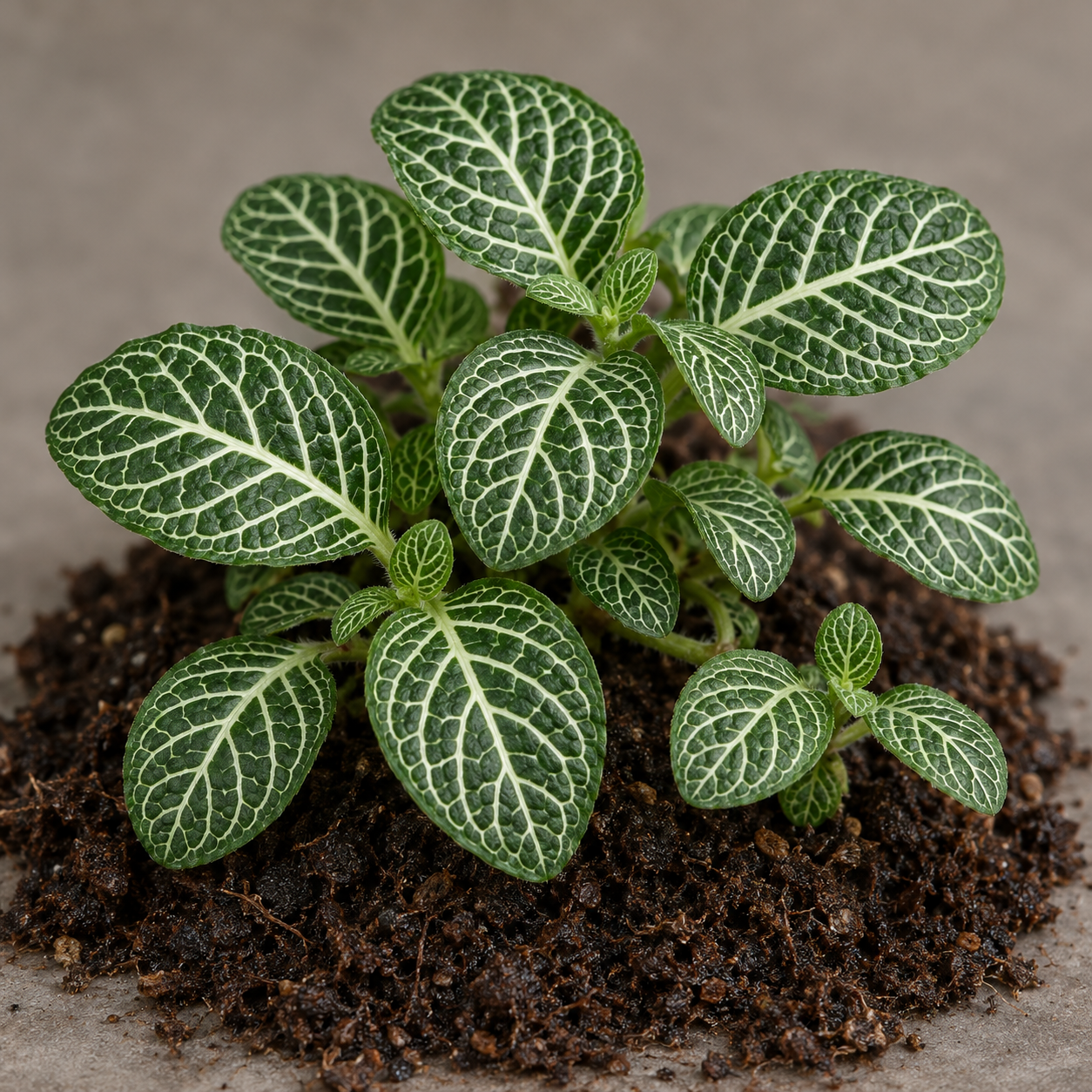
P001 Nerve plant
Fittonia albivenis
AI illustration · Intended subject: Fittonia albivenis. Not verified for species identification.
Reference care: Creeping, shallow-rooted foliage plant. Keep roots moist and drained in filtered light; dry air, strong sun and excess water can damage it. PS003
Enclosure use · inferred: Use a small-leaved, documented cultivar for a foreground patch and retain pruning access.
Also find as: Fittonia verschaffeltii; Fittonia argyroneura.
Size, propagation, identity and planning notes
Published dimensions · original units
Height: 0 ft. 3 in. - 0 ft. 8 in. | Width: 0 ft. 6 in. - 1 ft. 6 in.
Mature size and measurement limits
Published dimensions describe general horticultural growth, not a tested terrarium size or a required enclosure minimum. Cultivars and growing conditions vary.
Propagation from reference
Stem Cutting
Temperature and seasonality
No numeric optimum is standardized here. Confirm climate and seasonal care from the linked species reference.
Identity and naming
Name follows the cited horticultural treatment; purchased specimens have not been independently identified.
Family · source treatment
Acanthaceae
Substrate, mounting and air · design inference
Plant in an aerated root zone above any persistent reservoir; keep small foreground patches accessible.
Maintenance · design inference
Watch spread, remove dead material and thin planting before it excludes smaller neighbors.
Design limit
Humid air is not evidence that roots tolerate standing water.
Source exposure cautions
No specific exposure assessment entered; absence is not evidence of safety.
Animal safety
Not assessed for a particular terrarium animal. Plant performance and any human, cat or dog toxicity information do not establish safety for frogs, reptiles or herbivorous invertebrates. No feeding or cohabitation approval is implied.
Reference care: Textured foliage on creeping stems; the reference recommends warmth, humid air, bright indirect light and a draining organic medium. PS004
Enclosure use · inferred: Allow for a small mound rather than treating the plant as a thin moss carpet.
Group
Small foliage
Enclosure system · inferred
Humid terrestrial
Selection · inferred
Conditional candidate
Light tag · inferred
Bright indirect / filtered
Root moisture tag · inferred
Evenly moist
Record type
species
Published height
7.62–30.48 cm
Published spread
7.62–30.48 cm
Reported growth rate
Not quantified
Evidence: Enclosure application inferred from horticulture. Named-species horticulture. Reviewed 2026-10-16.
Size, propagation, identity and planning notes
Published dimensions · original units
Height: 0 ft. 3 in. - 1 ft. 0 in. | Width: 0 ft. 3 in. - 1 ft. 0 in.
Mature size and measurement limits
Published dimensions describe general horticultural growth, not a tested terrarium size or a required enclosure minimum. Cultivars and growing conditions vary.
Propagation from reference
Stem Cutting
Temperature and seasonality
No numeric optimum is standardized here. Confirm climate and seasonal care from the linked species reference.
Identity and naming
Name follows the cited horticultural treatment; purchased specimens have not been independently identified.
Family · source treatment
Urticaceae
Substrate, mounting and air · design inference
Plant in an aerated root zone above any persistent reservoir; keep small foreground patches accessible.
Maintenance · design inference
Watch spread, remove dead material and thin planting before it excludes smaller neighbors.
Design limit
Humid air is not evidence that roots tolerate standing water.
Source exposure cautions
No specific exposure assessment entered; absence is not evidence of safety.
Animal safety
Not assessed for a particular terrarium animal. Plant performance and any human, cat or dog toxicity information do not establish safety for frogs, reptiles or herbivorous invertebrates. No feeding or cohabitation approval is implied.
Reference care: Upright silver-marked foliage for humid filtered-light conditions. Pinching and replacement from cuttings help maintain compact growth. PS005
Enclosure use · inferred: Use as midground foliage with room above it; young nursery plants are not a separate miniature species.
Group
Small foliage
Enclosure system · inferred
Humid terrestrial
Selection · inferred
Conditional candidate
Light tag · inferred
Bright indirect / filtered
Root moisture tag · inferred
Evenly moist
Record type
species
Published height
22.86–30.48 cm
Published spread
15.24–22.86 cm
Reported growth rate
Medium
Evidence: Enclosure application inferred from horticulture. Named-species horticulture. Reviewed 2026-10-16.
Size, propagation, identity and planning notes
Published dimensions · original units
Height: 0 ft. 9 in. - 1 ft. 0 in. | Width: 0 ft. 6 in. - 0 ft. 9 in.
Mature size and measurement limits
Published dimensions describe general horticultural growth, not a tested terrarium size or a required enclosure minimum. Cultivars and growing conditions vary.
Propagation from reference
Stem Cutting
Temperature and seasonality
No numeric optimum is standardized here. Confirm climate and seasonal care from the linked species reference.
Identity and naming
Name follows the cited horticultural treatment; purchased specimens have not been independently identified.
Family · source treatment
Urticaceae
Substrate, mounting and air · design inference
Plant in an aerated root zone above any persistent reservoir; keep small foreground patches accessible.
Maintenance · design inference
Watch spread, remove dead material and thin planting before it excludes smaller neighbors.
Design limit
Humid air is not evidence that roots tolerate standing water.
Source exposure cautions
No specific exposure assessment entered; absence is not evidence of safety.
Animal safety
Not assessed for a particular terrarium animal. Plant performance and any human, cat or dog toxicity information do not establish safety for frogs, reptiles or herbivorous invertebrates. No feeding or cohabitation approval is implied.
Reference care: A vigorous, node-rooting creeper for humid conditions and moist but draining media; it can spread aggressively. PS006
Enclosure use · inferred: Keep it in an accessible patch so it can be thinned before covering slow growers.
Group
Groundcovers
Enclosure system · inferred
Humid terrestrial
Selection · inferred
Conditional candidate
Light tag · inferred
Bright indirect / filtered
Root moisture tag · inferred
Evenly moist
Record type
species
Published height
Not established / see size notes
Published spread
Not established / see size notes
Reported growth rate
Rapid
Evidence: Enclosure application inferred from horticulture. Named-species horticulture. Reviewed 2026-10-16.
Size, propagation, identity and planning notes
Published dimensions · original units
Not established
Mature size and measurement limits
Published dimensions describe general horticultural growth, not a tested terrarium size or a required enclosure minimum. Cultivars and growing conditions vary.
Propagation from reference
Division | Stem Cutting
Temperature and seasonality
No numeric optimum is standardized here. Confirm climate and seasonal care from the linked species reference.
Identity and naming
Use the source heading Pilea nummulariifolia; the species attribute on that page contains a spelling inconsistency.
Family · source treatment
Urticaceae
Substrate, mounting and air · design inference
Plant in an aerated root zone above any persistent reservoir; keep small foreground patches accessible.
Maintenance · design inference
Watch spread, remove dead material and thin planting before it excludes smaller neighbors.
Design limit
Humid air is not evidence that roots tolerate standing water.
Source exposure cautions
No specific exposure assessment entered; absence is not evidence of safety.
Animal safety
Not assessed for a particular terrarium animal. Plant performance and any human, cat or dog toxicity information do not establish safety for frogs, reptiles or herbivorous invertebrates. No feeding or cohabitation approval is implied.
Reference care: Fine-leaved mat-forming plant for indirect light and humid, drained conditions; both drying and excessive watering can cause problems. PS007
Enclosure use · inferred: Keep space for a leafy mound and monitor its spread into neighboring planting.
Height: 0 ft. 6 in. - 1 ft. 0 in. | Width: 0 ft. 6 in. - 2 ft. 0 in.
Mature size and measurement limits
Published dimensions describe general horticultural growth, not a tested terrarium size or a required enclosure minimum. Cultivars and growing conditions vary.
Propagation from reference
Stem Cutting
Temperature and seasonality
No numeric optimum is standardized here. Confirm climate and seasonal care from the linked species reference.
Identity and naming
Name follows the cited horticultural treatment; purchased specimens have not been independently identified.
Family · source treatment
Urticaceae
Substrate, mounting and air · design inference
Plant in an aerated root zone above any persistent reservoir; keep small foreground patches accessible.
Maintenance · design inference
Watch spread, remove dead material and thin planting before it excludes smaller neighbors.
Design limit
Humid air is not evidence that roots tolerate standing water.
Source exposure cautions
No specific exposure assessment entered; absence is not evidence of safety.
Animal safety
Not assessed for a particular terrarium animal. Plant performance and any human, cat or dog toxicity information do not establish safety for frogs, reptiles or herbivorous invertebrates. No feeding or cohabitation approval is implied.
Reference care: Compact, wrinkled foliage. The species reference favors filtered light and some drying between waterings; persistent wetness is a poor assumption. PS008
Enclosure use · inferred: Use an aerated root pocket rather than a saturated floor, even in a humid display.
Group
Small foliage
Enclosure system · inferred
Ventilated terrestrial
Selection · inferred
Conditional candidate
Light tag · inferred
Bright indirect / filtered
Root moisture tag · inferred
Partial drying
Record type
species
Published height
15.24–20.32 cm
Published spread
15.24–60.96 cm
Reported growth rate
Not quantified
Evidence: Enclosure application inferred from horticulture. Named-species horticulture. Reviewed 2026-10-16.
Size, propagation, identity and planning notes
Published dimensions · original units
Height: 0 ft. 6 in. - 0 ft. 8 in. | Width: 0 ft. 6 in. - 2 ft. 0 in.
Mature size and measurement limits
Published dimensions describe general horticultural growth, not a tested terrarium size or a required enclosure minimum. Cultivars and growing conditions vary.
Propagation from reference
Leaf Cutting | Stem Cutting
Temperature and seasonality
No numeric optimum is standardized here. Confirm climate and seasonal care from the linked species reference.
Identity and naming
Name follows the cited horticultural treatment; purchased specimens have not been independently identified.
Family · source treatment
Piperaceae
Substrate, mounting and air · design inference
Use a separately accessible, drainable root zone whose surface can dry as described by the species source.
Maintenance · design inference
Check roots and media before adding water; a permanently damp display may require a different plant.
Design limit
Do not infer bog tolerance from small leaves or tropical origin.
Source exposure cautions
No specific exposure assessment entered; absence is not evidence of safety.
Animal safety
Not assessed for a particular terrarium animal. Plant performance and any human, cat or dog toxicity information do not establish safety for frogs, reptiles or herbivorous invertebrates. No feeding or cohabitation approval is implied.
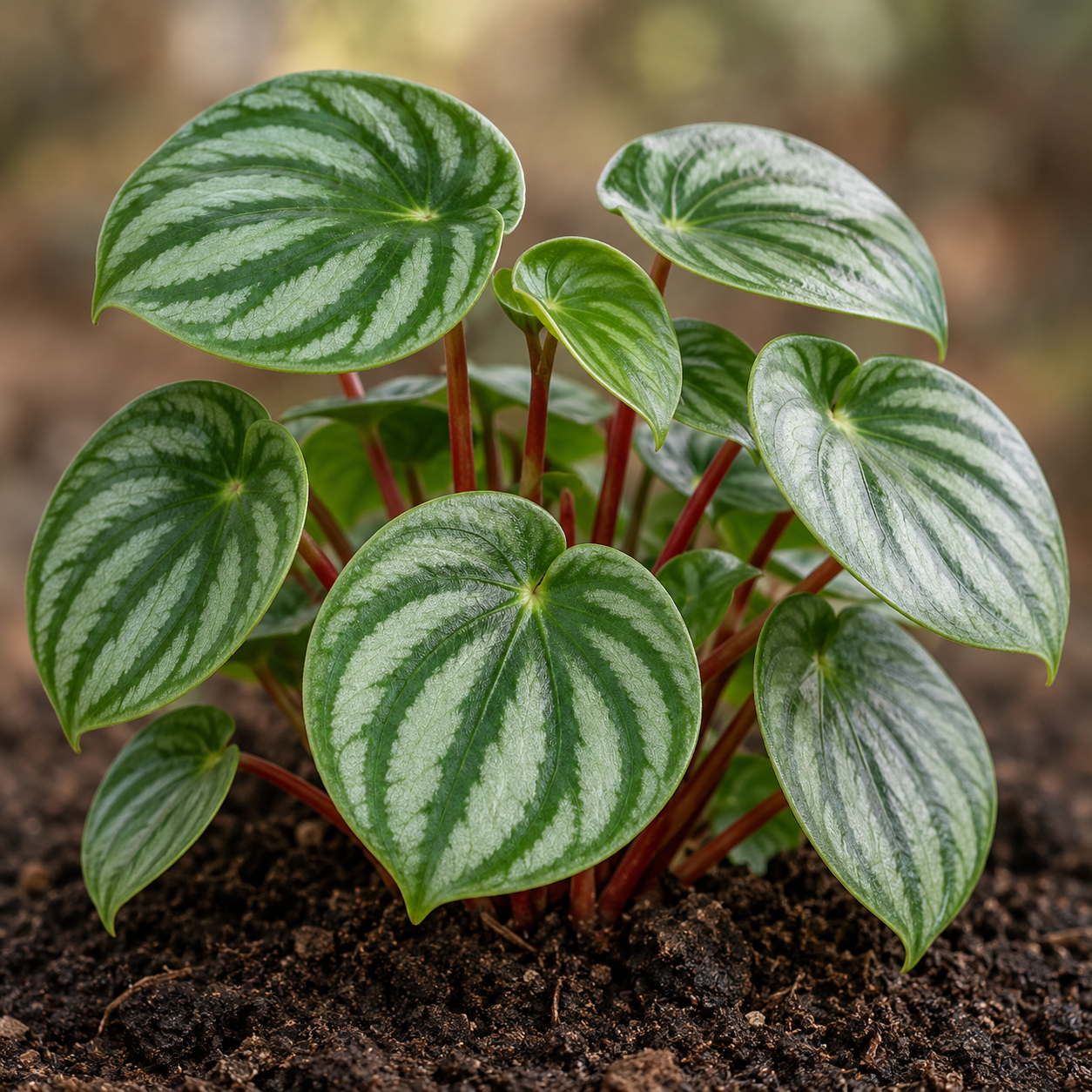
AI illustration · Intended subject: Peperomia argyraea. Not verified for species identification.
Reference care: Rounded striped foliage for indirect light. Avoid both very dry and waterlogged soil; let the upper surface begin drying before watering. PS009
Enclosure use · inferred: Allow space for the leaf spread and keep its root pocket accessible.
Group
Small foliage
Enclosure system · inferred
Ventilated terrestrial
Selection · inferred
Conditional candidate
Light tag · inferred
Bright indirect / filtered
Root moisture tag · inferred
Partial drying
Record type
species
Published height
Up to 20.32 cm
Published spread
Not established / see size notes
Reported growth rate
Slow
Evidence: Enclosure application inferred from horticulture. Named-species horticulture. Reviewed 2026-10-16.
Also find as: Peperomia sandersii; Peperomia argyreia.
Size, propagation, identity and planning notes
Published dimensions · original units
Not established
Mature size and measurement limits
Description gives height up to 8 inches (20.32 cm); no measured terrarium spread or miniature-cultivar size established.
Propagation from reference
Division | Leaf Cutting
Temperature and seasonality
No numeric optimum is standardized here. Confirm climate and seasonal care from the linked species reference.
Identity and naming
Kew POWO accepts Peperomia argyraea W.Bull and lists P. argyreia and P. sandersii as synonyms. The familiar argyreia trade spelling remains searchable. The stable record ID is unchanged.
Family · source treatment
Piperaceae
Substrate, mounting and air · design inference
Use a separately accessible, drainable root zone whose surface can dry as described by the species source.
Maintenance · design inference
Check roots and media before adding water; a permanently damp display may require a different plant.
Design limit
Do not infer bog tolerance from small leaves or tropical origin.
Source exposure cautions
No specific exposure assessment entered; absence is not evidence of safety.
Animal safety
Not assessed for a particular terrarium animal. Plant performance and any human, cat or dog toxicity information do not establish safety for frogs, reptiles or herbivorous invertebrates. No feeding or cohabitation approval is implied.
Reference care: Upright fleshy-leaved plant; the reference favors indirect light and a root zone that is not continuously wet. It can reach two feet tall. PS010
Enclosure use · inferred: Use only where mature bulk is acceptable; a small nursery pot does not establish long-term suitability.
Group
Small foliage
Enclosure system · inferred
Ventilated terrestrial
Selection · inferred
Space-demanding comparison
Light tag · inferred
Bright indirect / filtered
Root moisture tag · inferred
Partial drying
Record type
species
Published height
15.24–60.96 cm
Published spread
15.24–60.96 cm
Reported growth rate
Medium
Evidence: Enclosure application inferred from horticulture. Named-species horticulture. Reviewed 2026-10-16.
Size, propagation, identity and planning notes
Published dimensions · original units
Height: 0 ft. 6 in. - 2 ft. 0 in. | Width: 0 ft. 6 in. - 2 ft. 0 in.
Mature size and measurement limits
Published dimensions describe general horticultural growth, not a tested terrarium size or a required enclosure minimum. Cultivars and growing conditions vary.
Propagation from reference
Leaf Cutting | Stem Cutting
Temperature and seasonality
No numeric optimum is standardized here. Confirm climate and seasonal care from the linked species reference.
Identity and naming
Name follows the cited horticultural treatment; purchased specimens have not been independently identified.
Family · source treatment
Piperaceae
Substrate, mounting and air · design inference
Use a separately accessible, drainable root zone whose surface can dry as described by the species source.
Maintenance · design inference
Check roots and media before adding water; a permanently damp display may require a different plant.
Design limit
Do not infer bog tolerance from small leaves or tropical origin.
Source exposure cautions
No specific exposure assessment entered; absence is not evidence of safety.
Animal safety
Not assessed for a particular terrarium animal. Plant performance and any human, cat or dog toxicity information do not establish safety for frogs, reptiles or herbivorous invertebrates. No feeding or cohabitation approval is implied.
Reference care: Small round leaves on creeping or trailing stems; prefers indirect light, humid air and a moist, draining root zone. PS011
Enclosure use · inferred: Train on a low mount or accessible ledge, leaving room for trailing stems.
Group
Groundcovers
Enclosure system · inferred
Mounted humid
Selection · inferred
Conditional candidate
Light tag · inferred
Bright indirect / filtered
Root moisture tag · inferred
Evenly moist
Record type
species
Published height
Not established / see size notes
Published spread
Not established / see size notes
Reported growth rate
Slow
Evidence: Enclosure application inferred from horticulture. Named-species horticulture. Reviewed 2026-10-16.
Size, propagation, identity and planning notes
Published dimensions · original units
Not established
Mature size and measurement limits
Published dimensions describe general horticultural growth, not a tested terrarium size or a required enclosure minimum. Cultivars and growing conditions vary.
Propagation from reference
Stem Cutting
Temperature and seasonality
No numeric optimum is standardized here. Confirm climate and seasonal care from the linked species reference.
Identity and naming
Name follows the cited horticultural treatment; purchased specimens have not been independently identified.
Family · source treatment
Piperaceae
Substrate, mounting and air · design inference
Secure a small division on stable wood, rock or background with room for expanding rhizomes or stems.
Maintenance · design inference
Inspect attachment points and prevent neighboring moss from smothering growing tips.
Design limit
Root/rhizome aeration and an accessible mounting surface remain necessary.
Source exposure cautions
No specific exposure assessment entered; absence is not evidence of safety.
Animal safety
Not assessed for a particular terrarium animal. Plant performance and any human, cat or dog toxicity information do not establish safety for frogs, reptiles or herbivorous invertebrates. No feeding or cohabitation approval is implied.
Height: 0 ft. 9 in. - 1 ft. 0 in. | Width: 0 ft. 3 in. - 0 ft. 4 in.
Mature size and measurement limits
Source prose describes stems up to 12 inches long, but the dimension field labels 9–12 inches as height. Height/spread numbers are left null because the axis is ambiguous.
Propagation from reference
Leaf Cutting
Temperature and seasonality
No numeric optimum is standardized here. Confirm climate and seasonal care from the linked species reference.
Identity and naming
Name follows the cited horticultural treatment; purchased specimens have not been independently identified.
Family · source treatment
Piperaceae
Substrate, mounting and air · design inference
Use a separately accessible, drainable root zone whose surface can dry as described by the species source.
Maintenance · design inference
Check roots and media before adding water; a permanently damp display may require a different plant.
Design limit
Do not infer bog tolerance from small leaves or tropical origin.
Source exposure cautions
No specific exposure assessment entered; absence is not evidence of safety.
Animal safety
Not assessed for a particular terrarium animal. Plant performance and any human, cat or dog toxicity information do not establish safety for frogs, reptiles or herbivorous invertebrates. No feeding or cohabitation approval is implied.
Reference care: Tiny-leaved creeping groundcover for humid, moderately warm, indirectly lit conditions. The reference warns that it can crowd other terrarium plants. PS013
Enclosure use · inferred: Use a contained foreground patch and thin runners around miniature neighbors.
Height: 0 ft. 3 in. - 0 ft. 6 in. | Width: 3 ft. 0 in. - 6 ft. 0 in.
Mature size and measurement limits
Published dimensions describe general horticultural growth, not a tested terrarium size or a required enclosure minimum. Cultivars and growing conditions vary.
Propagation from reference
Division
Temperature and seasonality
No numeric optimum is standardized here. Confirm climate and seasonal care from the linked species reference.
Identity and naming
Name follows the cited horticultural treatment; purchased specimens have not been independently identified.
Family · source treatment
Urticaceae
Substrate, mounting and air · design inference
Plant in an aerated root zone above any persistent reservoir; keep small foreground patches accessible.
Maintenance · design inference
Watch spread, remove dead material and thin planting before it excludes smaller neighbors.
Design limit
Humid air is not evidence that roots tolerate standing water.
Source exposure cautions
No specific exposure assessment entered; absence is not evidence of safety.
Animal safety
Not assessed for a particular terrarium animal. Plant performance and any human, cat or dog toxicity information do not establish safety for frogs, reptiles or herbivorous invertebrates. No feeding or cohabitation approval is implied.
Height: 1 ft. 0 in. - 2 ft. 0 in. | Width: 0 ft. 9 in. - 1 ft. 0 in.
Mature size and measurement limits
Published dimensions describe general horticultural growth, not a tested terrarium size or a required enclosure minimum. Cultivars and growing conditions vary.
Propagation from reference
Seed | Stem Cutting
Temperature and seasonality
No numeric optimum is standardized here. Confirm climate and seasonal care from the linked species reference.
Identity and naming
Name follows the cited horticultural treatment; purchased specimens have not been independently identified.
Family · source treatment
Acanthaceae
Substrate, mounting and air · design inference
Plant in an aerated root zone above any persistent reservoir; keep small foreground patches accessible.
Maintenance · design inference
Watch spread, remove dead material and thin planting before it excludes smaller neighbors.
Design limit
Humid air is not evidence that roots tolerate standing water.
Source exposure cautions
No specific exposure assessment entered; absence is not evidence of safety.
Animal safety
Not assessed for a particular terrarium animal. Plant performance and any human, cat or dog toxicity information do not establish safety for frogs, reptiles or herbivorous invertebrates. No feeding or cohabitation approval is implied.
Reference care: Small fleshy leaves on rapidly rooting stems. Grow in filtered light and moist, aerated media; pruning controls spreading growth. PS015
Enclosure use · inferred: Keep in a reachable patch and prevent a dense mat from shading more delicate plants.
Group
Groundcovers
Enclosure system · inferred
Ventilated terrestrial
Selection · inferred
Conditional candidate
Light tag · inferred
Bright indirect / filtered
Root moisture tag · inferred
Evenly moist
Record type
species
Published height
10.16–15.24 cm
Published spread
60.96–121.92 cm
Reported growth rate
Rapid
Evidence: Enclosure application inferred from horticulture. Named-species horticulture. Reviewed 2026-10-16.
Size, propagation, identity and planning notes
Published dimensions · original units
Height: 0 ft. 4 in. - 0 ft. 6 in. | Width: 2 ft. 0 in. - 4 ft. 0 in.
Mature size and measurement limits
Published dimensions describe general horticultural growth, not a tested terrarium size or a required enclosure minimum. Cultivars and growing conditions vary.
Propagation from reference
Stem Cutting
Temperature and seasonality
No numeric optimum is standardized here. Confirm climate and seasonal care from the linked species reference.
Identity and naming
Name follows the cited horticultural treatment; purchased specimens have not been independently identified.
Family · source treatment
Commelinaceae
Substrate, mounting and air · design inference
Use a separately accessible, drainable root zone whose surface can dry as described by the species source.
Maintenance · design inference
Check roots and media before adding water; a permanently damp display may require a different plant.
Design limit
Do not infer bog tolerance from small leaves or tropical origin.
Source exposure cautions
No specific exposure assessment entered; absence is not evidence of safety.
Animal safety
Not assessed for a particular terrarium animal. Plant performance and any human, cat or dog toxicity information do not establish safety for frogs, reptiles or herbivorous invertebrates. No feeding or cohabitation approval is implied.
Also find as: Pellionia repens; Elatostema repens.
Size, propagation, identity and planning notes
Published dimensions · original units
Height: 0 ft. 3 in. - 0 ft. 6 in. | Width: 1 ft. 0 in. - 6 ft. 0 in.
Mature size and measurement limits
The source description gives spread to 2 feet while its dimension field extends to 6 feet. Spread is not standardized here; plan for a vigorous creeper.
Propagation from reference
Stem Cutting
Temperature and seasonality
No numeric optimum is standardized here. Confirm climate and seasonal care from the linked species reference.
Identity and naming
Pellionia repens and Elatostema repens resolve to the same Procris repens reference, so they are one record. Despite the common name this is not a Begonia.
Family · source treatment
Urticaceae
Substrate, mounting and air · design inference
Plant in an aerated root zone above any persistent reservoir; keep small foreground patches accessible.
Maintenance · design inference
Watch spread, remove dead material and thin planting before it excludes smaller neighbors.
Design limit
Humid air is not evidence that roots tolerate standing water.
Source exposure cautions
No specific exposure assessment entered; absence is not evidence of safety.
Animal safety
Not assessed for a particular terrarium animal. Plant performance and any human, cat or dog toxicity information do not establish safety for frogs, reptiles or herbivorous invertebrates. No feeding or cohabitation approval is implied.
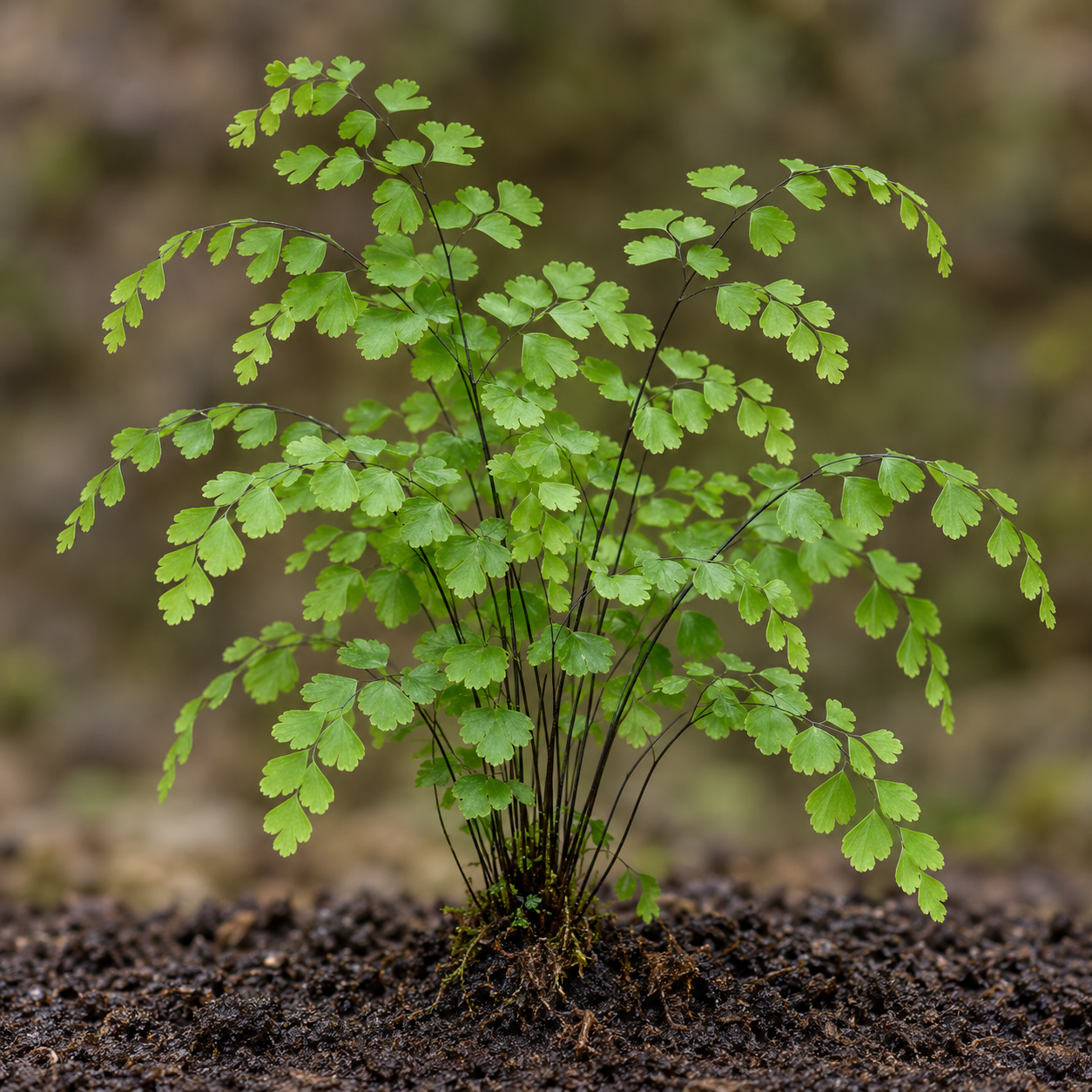
AI illustration · Intended subject: Adiantum raddianum. Not verified for species identification.
Reference care: A rhizomatous fern for humid air, shade or filtered light and consistently moist roots. The reference describes plants one to two feet high and wide. PS017
Enclosure use · inferred: Use in a roomy floor planting; protect fragile fronds from trampling and do not let the root zone dry.
Height: 1 ft. 0 in. - 2 ft. 0 in. | Width: 1 ft. 0 in. - 2 ft. 0 in.
Mature size and measurement limits
Published dimensions describe general horticultural growth, not a tested terrarium size or a required enclosure minimum. Cultivars and growing conditions vary.
Propagation from reference
Division
Temperature and seasonality
No numeric optimum is standardized here. Confirm climate and seasonal care from the linked species reference.
Identity and naming
Name follows the cited horticultural treatment; purchased specimens have not been independently identified.
Family · source treatment
Pteridaceae
Substrate, mounting and air · design inference
Plant in an aerated root zone above any persistent reservoir; keep small foreground patches accessible.
Maintenance · design inference
Watch spread, remove dead material and thin planting before it excludes smaller neighbors.
Design limit
Humid air is not evidence that roots tolerate standing water.
Source exposure cautions
No specific exposure assessment entered; absence is not evidence of safety.
Animal safety
Not assessed for a particular terrarium animal. Plant performance and any human, cat or dog toxicity information do not establish safety for frogs, reptiles or herbivorous invertebrates. No feeding or cohabitation approval is implied.
Reference care: A large rosette-forming tropical epiphyte; requires moisture and drainage rather than dry conditions. PS018
Enclosure use · inferred: A large-enclosure comparison. Do not infer a tabletop fit from a young rosette.
Group
Ferns
Enclosure system · inferred
Mounted humid
Selection · inferred
Space-demanding comparison
Light tag · inferred
Bright indirect / filtered
Root moisture tag · inferred
Evenly moist
Record type
species
Published height
91.44–152.4 cm
Published spread
60.96–91.44 cm
Reported growth rate
Slow
Evidence: Enclosure application inferred from horticulture. Named-species horticulture. Reviewed 2026-10-16.
Size, propagation, identity and planning notes
Published dimensions · original units
Height: 3 ft. 0 in. - 5 ft. 0 in. | Width: 2 ft. 0 in. - 3 ft. 0 in.
Mature size and measurement limits
Published dimensions describe general horticultural growth, not a tested terrarium size or a required enclosure minimum. Cultivars and growing conditions vary.
Propagation from reference
Not established in reviewed material
Temperature and seasonality
No numeric optimum is standardized here. Confirm climate and seasonal care from the linked species reference.
Identity and naming
Name follows the cited horticultural treatment; purchased specimens have not been independently identified.
Family · source treatment
Aspleniaceae
Substrate, mounting and air · design inference
Secure a small division on stable wood, rock or background with room for expanding rhizomes or stems.
Maintenance · design inference
Inspect attachment points and prevent neighboring moss from smothering growing tips.
Design limit
Root/rhizome aeration and an accessible mounting surface remain necessary.
Source exposure cautions
No specific exposure assessment entered; absence is not evidence of safety.
Animal safety
Not assessed for a particular terrarium animal. Plant performance and any human, cat or dog toxicity information do not establish safety for frogs, reptiles or herbivorous invertebrates. No feeding or cohabitation approval is implied.
Reference care: Shade-tolerant fern with moist, draining root requirements; arching fronds produce young plantlets and may reach about four feet. PS019
Enclosure use · inferred: Large-display comparison; allow space for fronds and inspect naturally developing plantlets.
Group
Ferns
Enclosure system · inferred
Humid terrestrial
Selection · inferred
Space-demanding comparison
Light tag · inferred
Bright indirect / filtered
Root moisture tag · inferred
Evenly moist
Record type
species
Published height
Up to 121.92 cm
Published spread
Not established / see size notes
Reported growth rate
Medium
Evidence: Enclosure application inferred from horticulture. Named-species horticulture. Reviewed 2026-10-16.
Size, propagation, identity and planning notes
Published dimensions · original units
Not established
Mature size and measurement limits
Source prose describes fronds to 4 feet (121.92 cm); this is not a miniature fern size.
Propagation from reference
Plantlets; spores
Temperature and seasonality
No numeric optimum is standardized here. Confirm climate and seasonal care from the linked species reference.
Identity and naming
Name follows the cited horticultural treatment; purchased specimens have not been independently identified.
Family · source treatment
Aspleniaceae
Substrate, mounting and air · design inference
Plant in an aerated root zone above any persistent reservoir; keep small foreground patches accessible.
Maintenance · design inference
Watch spread, remove dead material and thin planting before it excludes smaller neighbors.
Design limit
Humid air is not evidence that roots tolerate standing water.
Source exposure cautions
No specific exposure assessment entered; absence is not evidence of safety.
Animal safety
Not assessed for a particular terrarium animal. Plant performance and any human, cat or dog toxicity information do not establish safety for frogs, reptiles or herbivorous invertebrates. No feeding or cohabitation approval is implied.
Reference care: A vigorous fern needing moist roots, humid air and indirect light; species-level dimensions are much larger than many terrarium openings. PS020
Enclosure use · inferred: Large-enclosure comparison. Compact named cultivars require their own size evidence.
Group
Ferns
Enclosure system · inferred
Humid terrestrial
Selection · inferred
Space-demanding comparison
Light tag · inferred
Bright indirect / filtered
Root moisture tag · inferred
Evenly moist
Record type
species
Published height
60.96–91.44 cm
Published spread
60.96–91.44 cm
Reported growth rate
Rapid
Evidence: Enclosure application inferred from horticulture. Named-species horticulture. Reviewed 2026-10-16.
Size, propagation, identity and planning notes
Published dimensions · original units
Height: 2 ft. 0 in. - 3 ft. 0 in. | Width: 2 ft. 0 in. - 3 ft. 0 in.
Mature size and measurement limits
Published dimensions describe general horticultural growth, not a tested terrarium size or a required enclosure minimum. Cultivars and growing conditions vary.
Propagation from reference
Not established in reviewed material
Temperature and seasonality
No numeric optimum is standardized here. Confirm climate and seasonal care from the linked species reference.
Identity and naming
Name follows the cited horticultural treatment; purchased specimens have not been independently identified.
Family · source treatment
Polypodiaceae
Substrate, mounting and air · design inference
Plant in an aerated root zone above any persistent reservoir; keep small foreground patches accessible.
Maintenance · design inference
Watch spread, remove dead material and thin planting before it excludes smaller neighbors.
Design limit
Humid air is not evidence that roots tolerate standing water.
Source exposure cautions
No specific exposure assessment entered; absence is not evidence of safety.
Animal safety
Not assessed for a particular terrarium animal. Plant performance and any human, cat or dog toxicity information do not establish safety for frogs, reptiles or herbivorous invertebrates. No feeding or cohabitation approval is implied.
Reference care: Fuzzy rhizomes creep over the support. Keep media moist with slight surface drying; propagate rhizome pieces bearing fronds. PS021
Enclosure use · inferred: Keep rhizomes exposed on a roomy mount or surface rather than burying them under a moss carpet.
Group
Ferns
Enclosure system · inferred
Mounted humid
Selection · inferred
Conditional candidate
Light tag · inferred
Bright indirect / filtered
Root moisture tag · inferred
Evenly moist
Record type
species
Published height
Not established / see size notes
Published spread
Not established / see size notes
Reported growth rate
Medium
Evidence: Enclosure application inferred from horticulture. Named-species horticulture. Reviewed 2026-10-16.
Size, propagation, identity and planning notes
Published dimensions · original units
Not established
Mature size and measurement limits
Published dimensions describe general horticultural growth, not a tested terrarium size or a required enclosure minimum. Cultivars and growing conditions vary.
Propagation from reference
Division | Root Cutting
Temperature and seasonality
No numeric optimum is standardized here. Confirm climate and seasonal care from the linked species reference.
Identity and naming
Name follows the cited horticultural treatment; purchased specimens have not been independently identified.
Family · source treatment
Polypodiaceae
Substrate, mounting and air · design inference
Secure a small division on stable wood, rock or background with room for expanding rhizomes or stems.
Maintenance · design inference
Inspect attachment points and prevent neighboring moss from smothering growing tips.
Design limit
Root/rhizome aeration and an accessible mounting surface remain necessary.
Source exposure cautions
No specific exposure assessment entered; absence is not evidence of safety.
Animal safety
Not assessed for a particular terrarium animal. Plant performance and any human, cat or dog toxicity information do not establish safety for frogs, reptiles or herbivorous invertebrates. No feeding or cohabitation approval is implied.
Reference care: Creeping epiphytic or terrestrial fern for filtered light and moist, draining media; allow the surface to begin drying before rewatering. PS022
Enclosure use · inferred: Provide an accessible spreading surface; verify the purchased culture’s identity.
Group
Ferns
Enclosure system · inferred
Mounted humid
Selection · inferred
Conditional candidate
Light tag · inferred
Bright indirect / filtered
Root moisture tag · inferred
Evenly moist
Record type
subspecies
Published height
Not established / see size notes
Published spread
Not established / see size notes
Reported growth rate
Medium
Evidence: Enclosure application inferred from horticulture. Horticultural group / cultivar guidance. Reviewed 2026-10-16.
Also find as: Microsorum diversifolium; Microsorum pustulatum.
Size, propagation, identity and planning notes
Published dimensions · original units
Not established
Mature size and measurement limits
Published dimensions describe general horticultural growth, not a tested terrarium size or a required enclosure minimum. Cultivars and growing conditions vary.
Propagation from reference
Root Cutting
Temperature and seasonality
No numeric optimum is standardized here. Confirm climate and seasonal care from the linked species reference.
Identity and naming
NC State treats the plant formerly sold as Microsorum diversifolium as Lecanopteris pustulata subsp. pustulata. Its heading has a subp./subsp. typographical inconsistency; the taxon field is followed here.
Family · source treatment
Polypodiaceae
Substrate, mounting and air · design inference
Secure a small division on stable wood, rock or background with room for expanding rhizomes or stems.
Maintenance · design inference
Inspect attachment points and prevent neighboring moss from smothering growing tips.
Design limit
Root/rhizome aeration and an accessible mounting surface remain necessary.
Source exposure cautions
No specific exposure assessment entered; absence is not evidence of safety.
Animal safety
Not assessed for a particular terrarium animal. Plant performance and any human, cat or dog toxicity information do not establish safety for frogs, reptiles or herbivorous invertebrates. No feeding or cohabitation approval is implied.
Reference care: A rhizomatous epiphyte with large fronds; favors humidity, air movement and moist but aerated organic media. PS023
Enclosure use · inferred: Large-enclosure comparison; give the rhizome room and do not cover it with saturated substrate.
Group
Ferns
Enclosure system · inferred
Mounted humid
Selection · inferred
Space-demanding comparison
Light tag · inferred
Bright indirect / filtered
Root moisture tag · inferred
Evenly moist
Record type
species
Published height
60.96–121.92 cm
Published spread
91.44–182.88 cm
Reported growth rate
Medium
Evidence: Enclosure application inferred from horticulture. Named-species horticulture. Reviewed 2026-10-16.
Size, propagation, identity and planning notes
Published dimensions · original units
Height: 2 ft. 0 in. - 4 ft. 0 in. | Width: 3 ft. 0 in. - 6 ft. 0 in.
Mature size and measurement limits
Published dimensions describe general horticultural growth, not a tested terrarium size or a required enclosure minimum. Cultivars and growing conditions vary.
Propagation from reference
Division
Temperature and seasonality
No numeric optimum is standardized here. Confirm climate and seasonal care from the linked species reference.
Identity and naming
Name follows the cited horticultural treatment; purchased specimens have not been independently identified.
Family · source treatment
Polypodiaceae
Substrate, mounting and air · design inference
Secure a small division on stable wood, rock or background with room for expanding rhizomes or stems.
Maintenance · design inference
Inspect attachment points and prevent neighboring moss from smothering growing tips.
Design limit
Root/rhizome aeration and an accessible mounting surface remain necessary.
Source exposure cautions
No specific exposure assessment entered; absence is not evidence of safety.
Animal safety
Not assessed for a particular terrarium animal. Plant performance and any human, cat or dog toxicity information do not establish safety for frogs, reptiles or herbivorous invertebrates. No feeding or cohabitation approval is implied.
Reference care: Mounted epiphyte with shield and fertile fronds. Provide filtered light and drainage, allowing slight drying without complete root desiccation. PS024
Enclosure use · inferred: Large mounted-display comparison with substantial space for mature fronds.
Group
Ferns
Enclosure system · inferred
Mounted with drying
Selection · inferred
Space-demanding comparison
Light tag · inferred
Bright indirect / filtered
Root moisture tag · inferred
Partial drying
Record type
species
Published height
60.96–91.44 cm
Published spread
60.96–91.44 cm
Reported growth rate
Slow
Evidence: Enclosure application inferred from horticulture. Named-species horticulture. Reviewed 2026-10-16.
Size, propagation, identity and planning notes
Published dimensions · original units
Height: 2 ft. 0 in. - 3 ft. 0 in. | Width: 2 ft. 0 in. - 3 ft. 0 in.
Mature size and measurement limits
Published dimensions describe general horticultural growth, not a tested terrarium size or a required enclosure minimum. Cultivars and growing conditions vary.
Propagation from reference
Division
Temperature and seasonality
No numeric optimum is standardized here. Confirm climate and seasonal care from the linked species reference.
Identity and naming
Name follows the cited horticultural treatment; purchased specimens have not been independently identified.
Family · source treatment
Polypodiaceae
Substrate, mounting and air · design inference
Use a ventilated mount accessible for thorough watering and drainage; do not bury an epiphytic plant as ordinary bedding.
Maintenance · design inference
Observe actual drying between waterings; avoid keeping water trapped against the base.
Design limit
High humidity does not replace watering or an appropriate drying cycle.
Source exposure cautions
No specific exposure assessment entered; absence is not evidence of safety.
Animal safety
Not assessed for a particular terrarium animal. Plant performance and any human, cat or dog toxicity information do not establish safety for frogs, reptiles or herbivorous invertebrates. No feeding or cohabitation approval is implied.
Reference care: A compact arching fern with round leaflets; tolerates less-humid conditions than many ferns and needs good drainage. PS025
Enclosure use · inferred: Use a drainable soil pocket rather than treating all fern roots as bog plants.
Group
Ferns
Enclosure system · inferred
Ventilated terrestrial
Selection · inferred
Conditional candidate
Light tag · inferred
Bright indirect / filtered
Root moisture tag · inferred
Partial drying
Record type
species
Published height
15.24–30.48 cm
Published spread
15.24–30.48 cm
Reported growth rate
Not quantified
Evidence: Enclosure application inferred from horticulture. Named-species horticulture. Reviewed 2026-10-16.
Also find as: Hemionitis rotundifolia.
Size, propagation, identity and planning notes
Published dimensions · original units
Height: 0 ft. 6 in. - 1 ft. 0 in. | Width: 0 ft. 6 in. - 1 ft. 0 in.
Mature size and measurement limits
Published dimensions describe general horticultural growth, not a tested terrarium size or a required enclosure minimum. Cultivars and growing conditions vary.
Propagation from reference
Root Cutting | Stem Cutting
Temperature and seasonality
No numeric optimum is standardized here. Confirm climate and seasonal care from the linked species reference.
Identity and naming
Pellaea rotundifolia is retained as the familiar trade name. NC State currently presents this under Hemionitis rotundifolia; generic treatment is not independently resolved here.
Family · source treatment
Pteridaceae
Substrate, mounting and air · design inference
Use a separately accessible, drainable root zone whose surface can dry as described by the species source.
Maintenance · design inference
Check roots and media before adding water; a permanently damp display may require a different plant.
Design limit
Do not infer bog tolerance from small leaves or tropical origin.
Source exposure cautions
No specific exposure assessment entered; absence is not evidence of safety.
Animal safety
Not assessed for a particular terrarium animal. Plant performance and any human, cat or dog toxicity information do not establish safety for frogs, reptiles or herbivorous invertebrates. No feeding or cohabitation approval is implied.
Height: 0 ft. 2 in. - 0 ft. 4 in. | Width: 1 ft. 0 in. - 1 ft. 6 in.
Mature size and measurement limits
Published dimensions describe general horticultural growth, not a tested terrarium size or a required enclosure minimum. Cultivars and growing conditions vary.
Propagation from reference
Division | Stem Cutting
Temperature and seasonality
No numeric optimum is standardized here. Confirm climate and seasonal care from the linked species reference.
Identity and naming
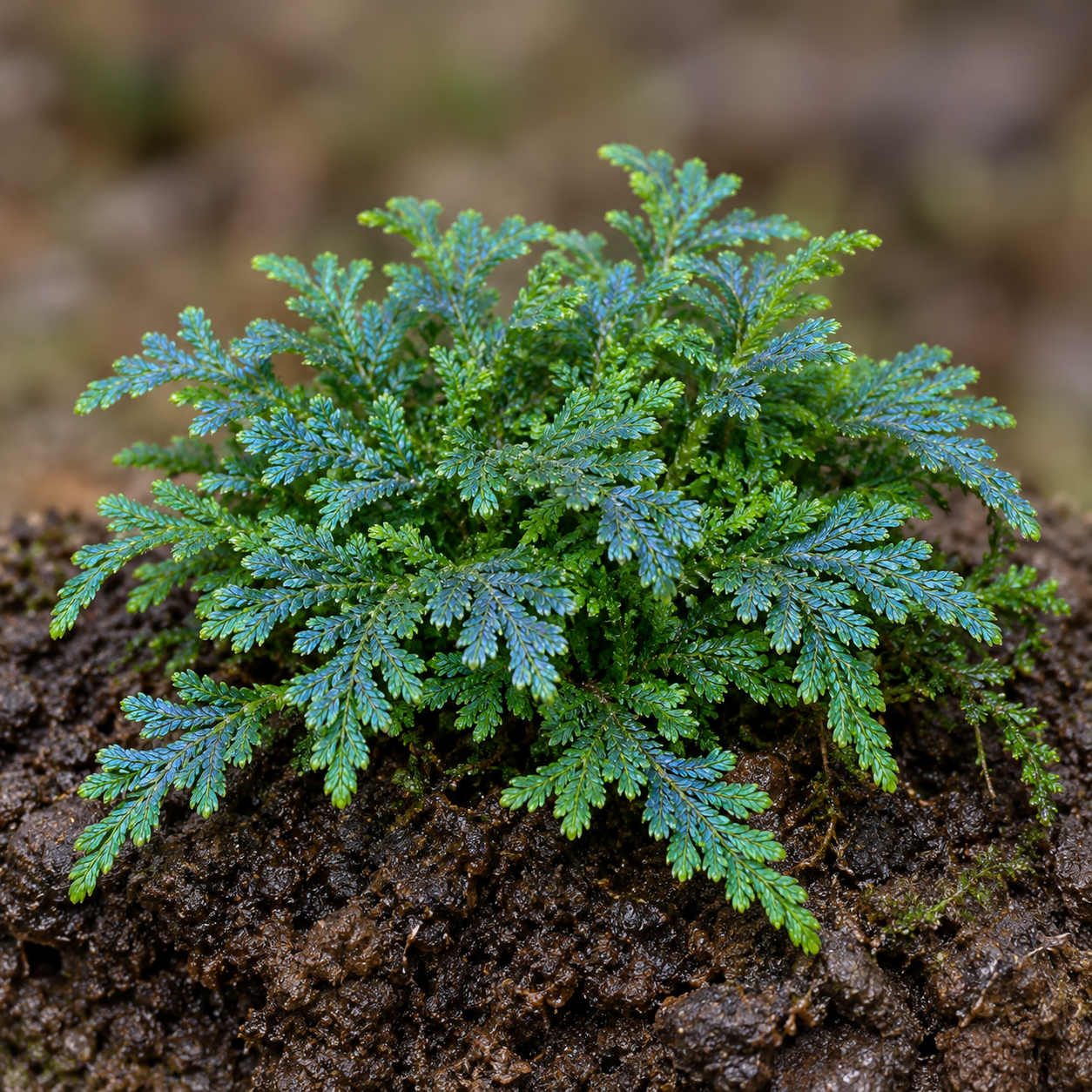
A vascular lycophyte, not a true moss; common names such as moss fern or tropical moss do not change that distinction.
Family · source treatment
Selaginellaceae
Substrate, mounting and air · design inference
Plant in an aerated root zone above any persistent reservoir; keep small foreground patches accessible.
Maintenance · design inference
Watch spread, remove dead material and thin planting before it excludes smaller neighbors.
Design limit
Humid air is not evidence that roots tolerate standing water.
Source exposure cautions
No specific exposure assessment entered; absence is not evidence of safety.
Animal safety
Not assessed for a particular terrarium animal. Plant performance and any human, cat or dog toxicity information do not establish safety for frogs, reptiles or herbivorous invertebrates. No feeding or cohabitation approval is implied.
Height: 0 ft. 3 in. - 0 ft. 6 in. | Width: 1 ft. 0 in. - 1 ft. 6 in.
Mature size and measurement limits
Published dimensions describe general horticultural growth, not a tested terrarium size or a required enclosure minimum. Cultivars and growing conditions vary.
Propagation from reference
Division | Stem Cutting
Temperature and seasonality
No numeric optimum is standardized here. Confirm climate and seasonal care from the linked species reference.
Identity and naming
A vascular lycophyte, not a true moss. The source has a misleading prose sentence calling it a moss; that sentence is not adopted.
Family · source treatment
Selaginellaceae
Substrate, mounting and air · design inference
Plant in an aerated root zone above any persistent reservoir; keep small foreground patches accessible.
Maintenance · design inference
Watch spread, remove dead material and thin planting before it excludes smaller neighbors.
Design limit
Humid air is not evidence that roots tolerate standing water.
Source exposure cautions
No specific exposure assessment entered; absence is not evidence of safety.
Animal safety
Not assessed for a particular terrarium animal. Plant performance and any human, cat or dog toxicity information do not establish safety for frogs, reptiles or herbivorous invertebrates. No feeding or cohabitation approval is implied.
Reference care: A vigorous woody climber that attaches by small roots; ordinary mature growth is many feet long. PS028
Enclosure use · inferred: Use only with reliable pruning and access to the whole background; a poor fit for a tiny unattended jar.
Group
Climbers
Enclosure system · inferred
Mounted humid
Selection · inferred
Pruning-intensive candidate
Light tag · inferred
Bright indirect / filtered
Root moisture tag · inferred
Evenly moist
Record type
species
Published height
243.84–457.2 cm
Published spread
91.44–182.88 cm
Reported growth rate
Rapid
Evidence: Enclosure application inferred from horticulture. Named-species horticulture. Reviewed 2026-10-16.
Size, propagation, identity and planning notes
Published dimensions · original units
Height: 8 ft. 0 in. - 15 ft. 0 in. | Width: 3 ft. 0 in. - 6 ft. 0 in.
Mature size and measurement limits
Published dimensions describe general horticultural growth, not a tested terrarium size or a required enclosure minimum. Cultivars and growing conditions vary.
Propagation from reference
Not established in reviewed material
Temperature and seasonality
No numeric optimum is standardized here. Confirm climate and seasonal care from the linked species reference.
Identity and naming
Name follows the cited horticultural treatment; purchased specimens have not been independently identified.
Family · source treatment
Moraceae
Substrate, mounting and air · design inference
Secure a small division on stable wood, rock or background with room for expanding rhizomes or stems.
Maintenance · design inference
Inspect attachment points and prevent neighboring moss from smothering growing tips.
Design limit
Root/rhizome aeration and an accessible mounting surface remain necessary.
Source exposure cautions
No specific exposure assessment entered; absence is not evidence of safety.
Animal safety
Not assessed for a particular terrarium animal. Plant performance and any human, cat or dog toxicity information do not establish safety for frogs, reptiles or herbivorous invertebrates. No feeding or cohabitation approval is implied.
Reference care: Juvenile plants are bushy, but adults develop climbing stems and altered foliage; the reference favors warmth, humidity and indirect light. PS029
Enclosure use · inferred: Large-display comparison; plan around adult climbing growth rather than the purchase size.
Group
Climbers
Enclosure system · inferred
Humid terrestrial
Selection · inferred
Space-demanding comparison
Light tag · inferred
Bright indirect / filtered
Root moisture tag · inferred
Evenly moist
Record type
species
Published height
91.44–182.88 cm
Published spread
30.48–60.96 cm
Reported growth rate
Not quantified
Evidence: Enclosure application inferred from horticulture. Named-species horticulture. Reviewed 2026-10-16.
Size, propagation, identity and planning notes
Published dimensions · original units
Height: 3 ft. 0 in. - 6 ft. 0 in. | Width: 1 ft. 0 in. - 2 ft. 0 in.
Mature size and measurement limits
Published dimensions describe general horticultural growth, not a tested terrarium size or a required enclosure minimum. Cultivars and growing conditions vary.
Propagation from reference
Division | Layering | Stem Cutting
Temperature and seasonality
No numeric optimum is standardized here. Confirm climate and seasonal care from the linked species reference.
Identity and naming
Name follows the cited horticultural treatment; purchased specimens have not been independently identified.
Family · source treatment
Araceae
Substrate, mounting and air · design inference
Plant in an aerated root zone above any persistent reservoir; keep small foreground patches accessible.
Maintenance · design inference
Watch spread, remove dead material and thin planting before it excludes smaller neighbors.
Design limit
Humid air is not evidence that roots tolerate standing water.
Source exposure cautions
NC State lists calcium oxalate crystals and contact dermatitis; ingestion effects are described primarily for mammalian exposure. This does not quantify risk to terrarium species.
Animal safety
Not assessed for a particular terrarium animal. Plant performance and any human, cat or dog toxicity information do not establish safety for frogs, reptiles or herbivorous invertebrates. No feeding or cohabitation approval is implied.
Reference care: A robust climbing or trailing aroid; indirect light and some media drying are preferred. Long vines remain possible even when leaves stay juvenile. PS030
Enclosure use · inferred: Use as a vigorous large-display vine with access for pruning; do not label it animal-safe from common enclosure use.
Group
Climbers
Enclosure system · inferred
Ventilated terrestrial
Selection · inferred
Pruning-intensive candidate
Light tag · inferred
Bright indirect / filtered
Root moisture tag · inferred
Partial drying
Record type
species
Published height
Not established / see size notes
Published spread
396.24–1219.2 cm
Reported growth rate
Medium
Evidence: Enclosure application inferred from horticulture. Named-species horticulture. Reviewed 2026-10-16.
Size, propagation, identity and planning notes
Published dimensions · original units
Height: 0 ft. 6 in. - 0 ft. 8 in. | Width: 13 ft. 0 in. - 40 ft. 0 in.
Mature size and measurement limits
Source dimension field gives 6–8 inches, but the description says 6–8 feet and vines to 40 feet. Numeric height is withheld because these conflict.
Propagation from reference
Stem Cutting
Temperature and seasonality
No numeric optimum is standardized here. Confirm climate and seasonal care from the linked species reference.
Identity and naming
Name follows the cited horticultural treatment; purchased specimens have not been independently identified.
Family · source treatment
Araceae
Substrate, mounting and air · design inference
Use a separately accessible, drainable root zone whose surface can dry as described by the species source.
Maintenance · design inference
Check roots and media before adding water; a permanently damp display may require a different plant.
Design limit
Do not infer bog tolerance from small leaves or tropical origin.
Source exposure cautions
NC State lists calcium oxalate crystals and contact dermatitis; its ingestion warning does not establish a species-specific reptile or amphibian risk level.
Animal safety
Not assessed for a particular terrarium animal. Plant performance and any human, cat or dog toxicity information do not establish safety for frogs, reptiles or herbivorous invertebrates. No feeding or cohabitation approval is implied.
Reference care: Trailing or climbing aroid for filtered light and a moist root zone; mature vines can greatly exceed the size of young houseplants. PS031
Enclosure use · inferred: Use in an accessible larger enclosure where growth can be redirected and pruned.
Group
Climbers
Enclosure system · inferred
Humid terrestrial
Selection · inferred
Pruning-intensive candidate
Light tag · inferred
Bright indirect / filtered
Root moisture tag · inferred
Evenly moist
Record type
species
Published height
Not established / see size notes
Published spread
15.24–182.88 cm
Reported growth rate
Rapid
Evidence: Enclosure application inferred from horticulture. Named-species horticulture. Reviewed 2026-10-16.
Size, propagation, identity and planning notes
Published dimensions · original units
Height: 0 ft. 4 in. - 6 ft. 0 in. | Width: 0 ft. 6 in. - 6 ft. 0 in.
Mature size and measurement limits
Source prose gives growth to 13 feet, while its dimension table ends at 6 feet. Height is not standardized here.
Propagation from reference
Stem Cutting
Temperature and seasonality
No numeric optimum is standardized here. Confirm climate and seasonal care from the linked species reference.
Identity and naming
Name follows the cited horticultural treatment; purchased specimens have not been independently identified.
Family · source treatment
Araceae
Substrate, mounting and air · design inference
Plant in an aerated root zone above any persistent reservoir; keep small foreground patches accessible.
Maintenance · design inference
Watch spread, remove dead material and thin planting before it excludes smaller neighbors.
Design limit
Humid air is not evidence that roots tolerate standing water.
Source exposure cautions
NC State lists calcium oxalate crystals and contact dermatitis. The human/mammalian warning is retained separately from unassessed terrarium-animal compatibility.
Animal safety
Not assessed for a particular terrarium animal. Plant performance and any human, cat or dog toxicity information do not establish safety for frogs, reptiles or herbivorous invertebrates. No feeding or cohabitation approval is implied.
Reference care: Silvery-leaved climbing aroid for indirect light and moist, well-drained media; adult growth reaches several feet. PS032
Enclosure use · inferred: Provide a climbing surface and pruning access; keep it from covering small epiphytes.
Group
Climbers
Enclosure system · inferred
Mounted humid
Selection · inferred
Pruning-intensive candidate
Light tag · inferred
Bright indirect / filtered
Root moisture tag · inferred
Evenly moist
Record type
species
Published height
91.44–304.8 cm
Published spread
60.96–121.92 cm
Reported growth rate
Slow
Evidence: Enclosure application inferred from horticulture. Named-species horticulture. Reviewed 2026-10-16.
Size, propagation, identity and planning notes
Published dimensions · original units
Height: 3 ft. 0 in. - 10 ft. 0 in. | Width: 2 ft. 0 in. - 4 ft. 0 in.
Mature size and measurement limits
Published dimensions describe general horticultural growth, not a tested terrarium size or a required enclosure minimum. Cultivars and growing conditions vary.
Propagation from reference
Stem Cutting
Temperature and seasonality
No numeric optimum is standardized here. Confirm climate and seasonal care from the linked species reference.
Identity and naming
Name follows the cited horticultural treatment; purchased specimens have not been independently identified.
Family · source treatment
Araceae
Substrate, mounting and air · design inference
Secure a small division on stable wood, rock or background with room for expanding rhizomes or stems.
Maintenance · design inference
Inspect attachment points and prevent neighboring moss from smothering growing tips.
Design limit
Root/rhizome aeration and an accessible mounting surface remain necessary.
Source exposure cautions
No specific exposure assessment entered; absence is not evidence of safety.
Animal safety
Not assessed for a particular terrarium animal. Plant performance and any human, cat or dog toxicity information do not establish safety for frogs, reptiles or herbivorous invertebrates. No feeding or cohabitation approval is implied.
Reference care: Small-leaved epiphytic vine with a slow trailing habit; it is sensitive to excess water and prefers drying between thorough waterings. PS033
Enclosure use · inferred: Use a ventilated ledge or mount whose roots can dry appropriately rather than a wet floor.
Group
Climbers
Enclosure system · inferred
Mounted with drying
Selection · inferred
Conditional candidate
Light tag · inferred
Bright indirect / filtered
Root moisture tag · inferred
Dry between waterings
Record type
species
Published height
5.08–7.62 cm
Published spread
30.48–91.44 cm
Reported growth rate
Slow
Evidence: Enclosure application inferred from horticulture. Named-species horticulture. Reviewed 2026-10-16.
Size, propagation, identity and planning notes
Published dimensions · original units
Height: 0 ft. 2 in. - 0 ft. 3 in. | Width: 1 ft. 0 in. - 3 ft. 0 in.
Mature size and measurement limits
Published dimensions describe general horticultural growth, not a tested terrarium size or a required enclosure minimum. Cultivars and growing conditions vary.
Propagation from reference
Stem Cutting
Temperature and seasonality
No numeric optimum is standardized here. Confirm climate and seasonal care from the linked species reference.
Identity and naming
Name follows the cited horticultural treatment; purchased specimens have not been independently identified.
Family · source treatment
Apocynaceae
Substrate, mounting and air · design inference
Use a ventilated mount accessible for thorough watering and drainage; do not bury an epiphytic plant as ordinary bedding.
Maintenance · design inference
Observe actual drying between waterings; avoid keeping water trapped against the base.
Design limit
High humidity does not replace watering or an appropriate drying cycle.
Source exposure cautions
No specific exposure assessment entered; absence is not evidence of safety.
Animal safety
Not assessed for a particular terrarium animal. Plant performance and any human, cat or dog toxicity information do not establish safety for frogs, reptiles or herbivorous invertebrates. No feeding or cohabitation approval is implied.
Height: 0 ft. 8 in. - 1 ft. 0 in. | Width: 1 ft. 0 in. - 2 ft. 0 in.
Mature size and measurement limits
Published dimensions describe general horticultural growth, not a tested terrarium size or a required enclosure minimum. Cultivars and growing conditions vary.
Propagation from reference
Leaf Cutting | Stem Cutting
Temperature and seasonality
No numeric optimum is standardized here. Confirm climate and seasonal care from the linked species reference.
Identity and naming
Name follows the cited horticultural treatment; purchased specimens have not been independently identified.
Family · source treatment
Gesneriaceae
Substrate, mounting and air · design inference
Plant in an aerated root zone above any persistent reservoir; keep small foreground patches accessible.
Maintenance · design inference
Watch spread, remove dead material and thin planting before it excludes smaller neighbors.
Design limit
Humid air is not evidence that roots tolerate standing water.
Source exposure cautions
No specific exposure assessment entered; absence is not evidence of safety.
Animal safety
Not assessed for a particular terrarium animal. Plant performance and any human, cat or dog toxicity information do not establish safety for frogs, reptiles or herbivorous invertebrates. No feeding or cohabitation approval is implied.
Reference care: Rhizomatous foliage hybrids need humidity with ventilation and draining media. Avoid keeping crowns or leaves persistently wet. PS035
Enclosure use · inferred: Use a verified compact cultivar and an accessible root pocket; group dimensions do not establish every cultivar’s size.
Group
Begonias
Enclosure system · inferred
Humid terrestrial
Selection · inferred
Conditional candidate
Light tag · inferred
Bright indirect / filtered
Root moisture tag · inferred
Evenly moist
Record type
cultivar group
Published height
30.48–45.72 cm
Published spread
30.48–45.72 cm
Reported growth rate
Not quantified
Evidence: Enclosure application inferred from horticulture. Horticultural group / cultivar guidance. Reviewed 2026-10-16.
Size, propagation, identity and planning notes
Published dimensions · original units
Height: 1 ft. 0 in. - 1 ft. 6 in. | Width: 1 ft. 0 in. - 1 ft. 6 in.
Mature size and measurement limits
Published dimensions describe general horticultural growth, not a tested terrarium size or a required enclosure minimum. Cultivars and growing conditions vary.
Propagation from reference
Division | Leaf Cutting | Stem Cutting
Temperature and seasonality
No numeric optimum is standardized here. Confirm climate and seasonal care from the linked species reference.
Identity and naming
A horticultural hybrid group, not the species Begonia rex. Cultivar identity and size need their own records when known.
Family · source treatment
Begoniaceae
Substrate, mounting and air · design inference
Plant in an aerated root zone above any persistent reservoir; keep small foreground patches accessible.
Maintenance · design inference
Watch spread, remove dead material and thin planting before it excludes smaller neighbors.
Design limit
Humid air is not evidence that roots tolerate standing water.
Source exposure cautions
NC State lists calcium oxalate, root/sap exposure and contact irritation; its cat/dog and grazing-animal observations are not a safety assessment for terrarium inhabitants.
Animal safety
Not assessed for a particular terrarium animal. Plant performance and any human, cat or dog toxicity information do not establish safety for frogs, reptiles or herbivorous invertebrates. No feeding or cohabitation approval is implied.
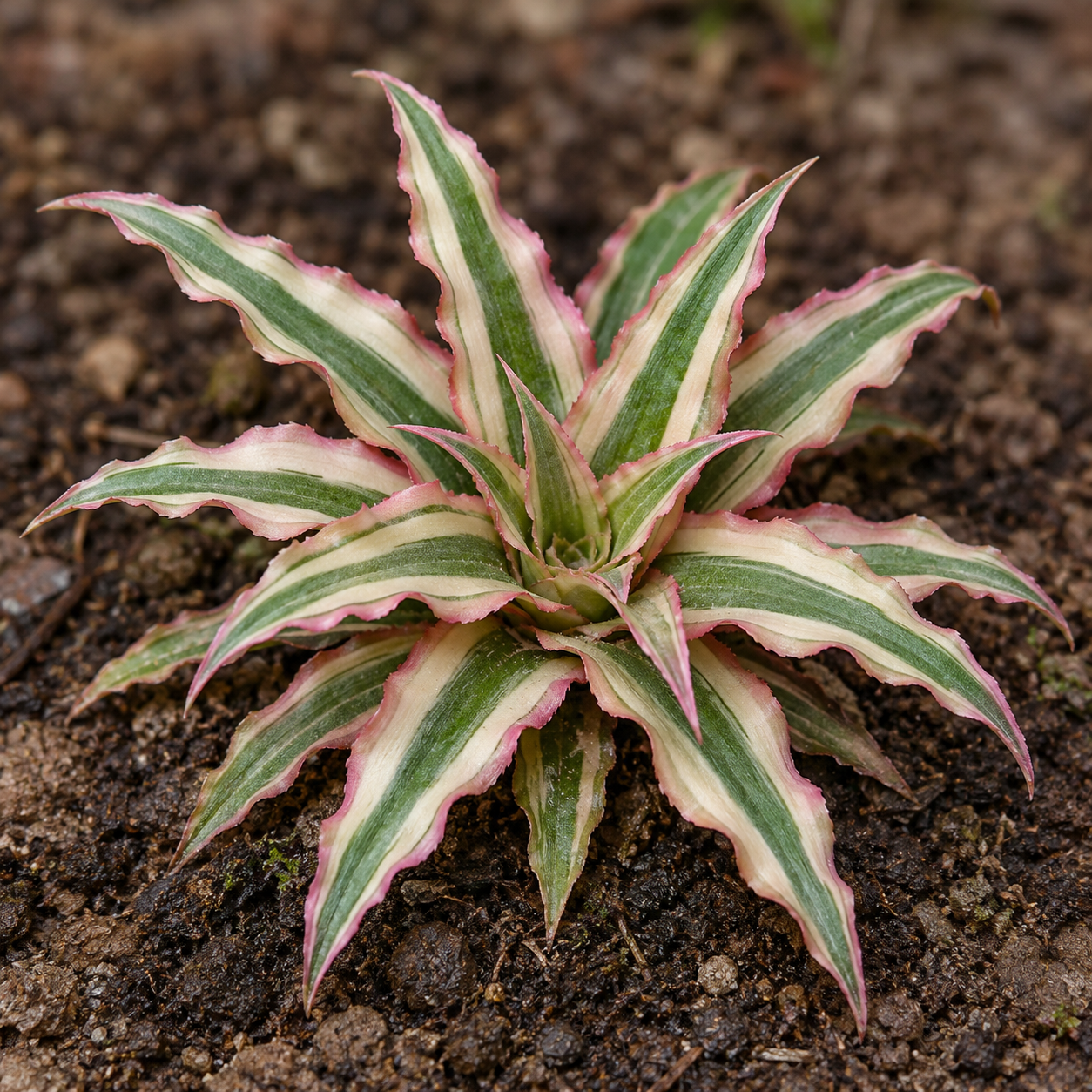
AI illustration · Intended subject: Cryptanthus bivittatus. Not verified for species identification.
Reference care: A terrestrial rosette, unlike tank-forming or mounted bromeliads. Use humus-rich draining soil and water the root zone as its surface begins drying. PS036
Enclosure use · inferred: Keep roots in a drained pocket and leave room for offsets; do not adopt a tank-bromeliad watering recipe.
Published dimensions describe general horticultural growth, not a tested terrarium size or a required enclosure minimum. Cultivars and growing conditions vary.
Propagation from reference
Division | Seed
Temperature and seasonality
No numeric optimum is standardized here. Confirm climate and seasonal care from the linked species reference.
Identity and naming
Name follows the cited horticultural treatment; purchased specimens have not been independently identified.
Family · source treatment
Bromeliaceae
Substrate, mounting and air · design inference
Use a separately accessible, drainable root zone whose surface can dry as described by the species source.
Maintenance · design inference
Check roots and media before adding water; a permanently damp display may require a different plant.
Design limit
Do not infer bog tolerance from small leaves or tropical origin.
Source exposure cautions
No specific exposure assessment entered; absence is not evidence of safety.
Animal safety
Not assessed for a particular terrarium animal. Plant performance and any human, cat or dog toxicity information do not establish safety for frogs, reptiles or herbivorous invertebrates. No feeding or cohabitation approval is implied.
Reference care: An epiphyte for indirect bright light; it needs thorough watering despite the air-plant name. Drain water from foliage and avoid planting it in soil. PS037
Enclosure use · inferred: Mount where water can drain and leaves can dry, with access to water the whole plant.
Group
Bromeliads
Enclosure system · inferred
Mounted with drying
Selection · inferred
Conditional candidate
Light tag · inferred
Bright indirect / filtered
Root moisture tag · inferred
Dry between waterings
Record type
species
Published height
15.24–30.48 cm
Published spread
10.16–20.32 cm
Reported growth rate
Medium
Evidence: Enclosure application inferred from horticulture. Named-species horticulture. Reviewed 2026-10-16.
Size, propagation, identity and planning notes
Published dimensions · original units
Height: 0 ft. 6 in. - 1 ft. 0 in. | Width: 0 ft. 4 in. - 0 ft. 8 in.
Mature size and measurement limits
Published dimensions describe general horticultural growth, not a tested terrarium size or a required enclosure minimum. Cultivars and growing conditions vary.
Propagation from reference
Not established in reviewed material
Temperature and seasonality
No numeric optimum is standardized here. Confirm climate and seasonal care from the linked species reference.
Identity and naming
Name follows the cited horticultural treatment; purchased specimens have not been independently identified.
Family · source treatment
Bromeliaceae
Substrate, mounting and air · design inference
Use a ventilated mount accessible for thorough watering and drainage; do not bury an epiphytic plant as ordinary bedding.
Maintenance · design inference
Observe actual drying between waterings; avoid keeping water trapped against the base.
Design limit
High humidity does not replace watering or an appropriate drying cycle.
Source exposure cautions
No specific exposure assessment entered; absence is not evidence of safety.
Animal safety
Not assessed for a particular terrarium animal. Plant performance and any human, cat or dog toxicity information do not establish safety for frogs, reptiles or herbivorous invertebrates. No feeding or cohabitation approval is implied.
Reference care: Rootless hanging epiphyte whose scales absorb water and nutrients. It forms trailing masses and is propagated by division. PS038
Enclosure use · inferred: Use only with room for a hanging strand and air exchange; it is neither a true moss nor a permanently wet groundcover.
Group
Bromeliads
Enclosure system · inferred
Mounted with drying
Selection · inferred
Conditional candidate
Light tag · inferred
Bright indirect / filtered
Root moisture tag · inferred
Dry between waterings
Record type
species
Published height
Not established / see size notes
Published spread
Not established / see size notes
Reported growth rate
Medium
Evidence: Enclosure application inferred from horticulture. Named-species horticulture. Reviewed 2026-10-16.
Size, propagation, identity and planning notes
Published dimensions · original units
Height: 0 ft. 10 in. - 3 ft. 0 in. | Width: 0 ft. 6 in. - 2 ft. 0 in.
Mature size and measurement limits
The source’s 10-inch to 3-foot height describes a hanging plant rather than an upright crown; no upright-height filter value is assigned.
Propagation from reference
Division | Seed
Temperature and seasonality
No numeric optimum is standardized here. Confirm climate and seasonal care from the linked species reference.
Identity and naming
Name follows the cited horticultural treatment; purchased specimens have not been independently identified.
Family · source treatment
Bromeliaceae
Substrate, mounting and air · design inference
Use a ventilated mount accessible for thorough watering and drainage; do not bury an epiphytic plant as ordinary bedding.
Maintenance · design inference
Observe actual drying between waterings; avoid keeping water trapped against the base.
Design limit
High humidity does not replace watering or an appropriate drying cycle.
Source exposure cautions
No specific exposure assessment entered; absence is not evidence of safety.
Animal safety
Not assessed for a particular terrarium animal. Plant performance and any human, cat or dog toxicity information do not establish safety for frogs, reptiles or herbivorous invertebrates. No feeding or cohabitation approval is implied.
Reference care: Terrestrial rhizomatous orchid with creeping stems and flower spikes. Keep roots consistently moist but drained, with humidity and air movement. PS039
Enclosure use · inferred: Use a shallow, roomy root pocket; allow extra vertical space for flower spikes.
Group
Orchids
Enclosure system · inferred
Humid terrestrial
Selection · inferred
Conditional candidate
Light tag · inferred
Bright indirect / filtered
Root moisture tag · inferred
Evenly moist
Record type
species
Published height
7.62–45.72 cm
Published spread
7.62–60.96 cm
Reported growth rate
Medium
Evidence: Enclosure application inferred from horticulture. Named-species horticulture. Reviewed 2026-10-16.
Size, propagation, identity and planning notes
Published dimensions · original units
Height: 0 ft. 3 in. - 1 ft. 6 in. | Width: 0 ft. 3 in. - 2 ft. 0 in.
Mature size and measurement limits
Published dimensions describe general horticultural growth, not a tested terrarium size or a required enclosure minimum. Cultivars and growing conditions vary.
Propagation from reference
Stem Cutting
Temperature and seasonality
No numeric optimum is standardized here. Confirm climate and seasonal care from the linked species reference.
Identity and naming
Name follows the cited horticultural treatment; purchased specimens have not been independently identified.
Family · source treatment
Orchidaceae
Substrate, mounting and air · design inference
Plant in an aerated root zone above any persistent reservoir; keep small foreground patches accessible.
Maintenance · design inference
Watch spread, remove dead material and thin planting before it excludes smaller neighbors.
Design limit
Humid air is not evidence that roots tolerate standing water.
Source exposure cautions
No specific exposure assessment entered; absence is not evidence of safety.
Animal safety
Not assessed for a particular terrarium animal. Plant performance and any human, cat or dog toxicity information do not establish safety for frogs, reptiles or herbivorous invertebrates. No feeding or cohabitation approval is implied.
Reference care: A spreading grass-like rhizomatous plant for very wet soil or partial submergence; dry soil can scorch leaves. PS040
Enclosure use · inferred: Keep foliage emerged on a maintained wet bank; partial-submergence evidence does not establish permanent whole-plant immersion.
Group
Wet-margin plants
Enclosure system · inferred
Wet margin / paludarium
Selection · inferred
Specialist system
Light tag · inferred
Bright indirect / filtered
Root moisture tag · inferred
Wet / saturated
Record type
species
Published height
15.24–30.48 cm
Published spread
15.24–30.48 cm
Reported growth rate
Medium
Evidence: Enclosure application inferred from horticulture. Named-species horticulture. Reviewed 2026-10-16.
Size, propagation, identity and planning notes
Published dimensions · original units
Height: 0 ft. 6 in. - 1 ft. 0 in. | Width: 0 ft. 6 in. - 1 ft. 0 in.
Mature size and measurement limits
Published dimensions describe general horticultural growth, not a tested terrarium size or a required enclosure minimum. Cultivars and growing conditions vary.
Propagation from reference
Not established in reviewed material
Temperature and seasonality
No numeric optimum is standardized here. Confirm climate and seasonal care from the linked species reference.
Identity and naming
Name follows the cited horticultural treatment; purchased specimens have not been independently identified.
Family · source treatment
Acoraceae
Substrate, mounting and air · design inference
Design an accessible waterline or wet support with emerged foliage; confirm depth tolerance for the actual plant.
Maintenance · design inference
Manage water quality and water level and remove decaying foliage.
Design limit
A wet-bank plant is not automatically a permanently submerged aquarium plant.
Source exposure cautions
No specific exposure assessment entered; absence is not evidence of safety.
Animal safety
Not assessed for a particular terrarium animal. Plant performance and any human, cat or dog toxicity information do not establish safety for frogs, reptiles or herbivorous invertebrates. No feeding or cohabitation approval is implied.
AI illustration · Intended subject: Dionaea muscipula. Not verified for species identification.
Reference care: High-light carnivore requiring low-mineral water and nutrient-controlled media; the ordinary shaded tropical terrarium recipe is unsuitable. PS041
Enclosure use · inferred: Keep in a dedicated bright carnivore compartment rather than a mixed fertilized forest floor.
Group
Carnivorous plants
Enclosure system · inferred
Specialist carnivore
Selection · inferred
Specialist system
Light tag · inferred
High / specialist light
Root moisture tag · inferred
Wet / saturated
Record type
species
Published height
15.24–30.48 cm
Published spread
15.24–20.32 cm
Reported growth rate
Slow
Evidence: Enclosure application inferred from horticulture. Named-species horticulture. Reviewed 2026-10-16.
Size, propagation, identity and planning notes
Published dimensions · original units
Height: 0 ft. 6 in. - 1 ft. 0 in. | Width: 0 ft. 6 in. - 0 ft. 8 in.
Mature size and measurement limits
Published dimensions describe general horticultural growth, not a tested terrarium size or a required enclosure minimum. Cultivars and growing conditions vary.
Propagation from reference
Division | Seed
Temperature and seasonality
Temperate natural history; cultivation regimes differ on dormancy. The separate ICPS source describes continuous indoor culture under strong light and regular feeding; no universal refrigerator treatment is asserted.
Identity and naming
Name follows the cited horticultural treatment; purchased specimens have not been independently identified.
Family · source treatment
Droseraceae
Substrate, mounting and air · design inference
Use a separate nutrient-controlled compartment with appropriate water quality and light; select for the actual species.
Maintenance · design inference
Monitor salts, shading and competing moss; use a species feeding and seasonal plan.
Design limit
Rich animal-enclosure soil and its fertilizer regime are not a default carnivore medium.
Source exposure cautions
No specific exposure assessment entered; absence is not evidence of safety.
Animal safety
Not assessed for a particular terrarium animal. Plant performance and any human, cat or dog toxicity information do not establish safety for frogs, reptiles or herbivorous invertebrates. No feeding or cohabitation approval is implied.
Reference care: Bog carnivore for strong light, acidic nutrient-poor media and low-mineral water. Its seasonal requirements differ from a warm tropical foliage display. PS042
Enclosure use · inferred: A separate seasonal bog comparison, not a default mixed terrarium inhabitant.
Group
Carnivorous plants
Enclosure system · inferred
Seasonal bog comparison
Selection · inferred
Comparison only
Light tag · inferred
High / specialist light
Root moisture tag · inferred
Wet / saturated
Record type
species
Published height
22.86–45.72 cm
Published spread
30.48–60.96 cm
Reported growth rate
Medium
Evidence: Enclosure application inferred from horticulture. Named-species horticulture. Reviewed 2026-10-16.
Size, propagation, identity and planning notes
Published dimensions · original units
Height: 0 ft. 9 in. - 1 ft. 6 in. | Width: 1 ft. 0 in. - 2 ft. 0 in.
Mature size and measurement limits
Published dimensions describe general horticultural growth, not a tested terrarium size or a required enclosure minimum. Cultivars and growing conditions vary.
Propagation from reference
Division | Seed
Temperature and seasonality
Confirm subspecies/provenance and a seasonal temperature plan; outdoor frost hardiness is not a terrarium temperature optimum.
Identity and naming
Name follows the cited horticultural treatment; purchased specimens have not been independently identified.
Family · source treatment
Sarraceniaceae
Substrate, mounting and air · design inference
Use a dedicated bright bog/container system whose seasonal plan follows species and provenance.
Maintenance · design inference
Measure water level and mineral accumulation; provide seasonal care rather than forcing a tropical community.
Design limit
Included to explain a common purchase mismatch; not a default warm humid terrarium selection.
Source exposure cautions
No specific exposure assessment entered; absence is not evidence of safety.
Animal safety
Not assessed for a particular terrarium animal. Plant performance and any human, cat or dog toxicity information do not establish safety for frogs, reptiles or herbivorous invertebrates. No feeding or cohabitation approval is implied.
Height: 0 ft. 4 in. - 1 ft. 0 in. | Width: 0 ft. 8 in. - 2 ft. 2 in.
Mature size and measurement limits
Published dimensions describe general horticultural growth, not a tested terrarium size or a required enclosure minimum. Cultivars and growing conditions vary.
Propagation from reference
Division | Leaf Cutting | Seed
Temperature and seasonality
No numeric optimum is standardized here. Confirm climate and seasonal care from the linked species reference.
Identity and naming
Name follows the cited horticultural treatment; purchased specimens have not been independently identified.
Family · source treatment
Asphodelaceae
Substrate, mounting and air · design inference
Use an open, well-ventilated, brightly lit container with genuinely drainable mineral-rich media.
Maintenance · design inference
Allow the root zone to dry as required; a glass container without a drain needs particular control of water input.
Design limit
An open top alone does not make wet, stagnant soil suitable for succulents.
Source exposure cautions
No specific exposure assessment entered; absence is not evidence of safety.
Animal safety
Not assessed for a particular terrarium animal. Plant performance and any human, cat or dog toxicity information do not establish safety for frogs, reptiles or herbivorous invertebrates. No feeding or cohabitation approval is implied.
Reference care: A woody succulent that becomes a shrub; requires bright light and drying between waterings. PS044
Enclosure use · inferred: Large dry-container comparison; a young cutting does not stay a tiny terrarium tree.
Group
Dry-habitat comparisons
Enclosure system · inferred
Dry open enclosure
Selection · inferred
Comparison only
Light tag · inferred
Bright / strong filtered
Root moisture tag · inferred
Dry between waterings
Record type
species
Published height
91.44–182.88 cm
Published spread
60.96–91.44 cm
Reported growth rate
Medium
Evidence: Enclosure application inferred from horticulture. Named-species horticulture. Reviewed 2026-10-16.
Size, propagation, identity and planning notes
Published dimensions · original units
Height: 3 ft. 0 in. - 6 ft. 0 in. | Width: 2 ft. 0 in. - 3 ft. 0 in.
Mature size and measurement limits
Published dimensions describe general horticultural growth, not a tested terrarium size or a required enclosure minimum. Cultivars and growing conditions vary.
Propagation from reference
Leaf Cutting | Stem Cutting
Temperature and seasonality
No numeric optimum is standardized here. Confirm climate and seasonal care from the linked species reference.
Identity and naming
Name follows the cited horticultural treatment; purchased specimens have not been independently identified.
Family · source treatment
Crassulaceae
Substrate, mounting and air · design inference
Use an open, well-ventilated, brightly lit container with genuinely drainable mineral-rich media.
Maintenance · design inference
Allow the root zone to dry as required; a glass container without a drain needs particular control of water input.
Design limit
An open top alone does not make wet, stagnant soil suitable for succulents.
Source exposure cautions
No specific exposure assessment entered; absence is not evidence of safety.
Animal safety
Not assessed for a particular terrarium animal. Plant performance and any human, cat or dog toxicity information do not establish safety for frogs, reptiles or herbivorous invertebrates. No feeding or cohabitation approval is implied.
Reference care: Named rhizomatous begonia in RHS care guidance; use drained media, protect the crown from persistent wetness and retain ventilation. PS045
Enclosure use · inferred: Investigate a labelled compact clone for a reachable foliage pocket; exact mature size is not established here.
Group
Begonias
Enclosure system · inferred
Humid terrestrial
Selection · inferred
Conditional candidate
Light tag · inferred
Bright indirect / filtered
Root moisture tag · inferred
Evenly moist
Record type
species
Published height
Not established / see size notes
Published spread
Not established / see size notes
Reported growth rate
Not quantified
Evidence: Enclosure application inferred from horticulture. Named species within shared rhizomatous-begonia care. Reviewed 2026-10-16.
Size, propagation, identity and planning notes
Published dimensions · original units
Not established
Mature size and measurement limits
Published dimensions describe general horticultural growth, not a tested terrarium size or a required enclosure minimum. Cultivars and growing conditions vary.
Propagation from reference
Rhizome cuttings; cultivar-specific method should be confirmed
Temperature and seasonality
RHS gives a 13 °C winter minimum for this species; this is not an optimum or a complete vivarium temperature range.
Identity and naming
Name follows the cited horticultural treatment; purchased specimens have not been independently identified.
Family · source treatment
Not standardized in this entry
Substrate, mounting and air · design inference
Plant in an aerated root zone above any persistent reservoir; keep small foreground patches accessible.
Maintenance · design inference
Watch spread, remove dead material and thin planting before it excludes smaller neighbors.
Design limit
Humid air is not evidence that roots tolerate standing water.
Source exposure cautions
No specific exposure assessment entered; absence is not evidence of safety.
Animal safety
Not assessed for a particular terrarium animal. Plant performance and any human, cat or dog toxicity information do not establish safety for frogs, reptiles or herbivorous invertebrates. No feeding or cohabitation approval is implied.
Grower describes foliage plants ¼–½ inch tall and up to 2 inches across; flower stalks extend beyond foliage.
Propagation from reference
Seed, tuber-clump division or leaf cuttings
Temperature and seasonality
Intermediate to warm cultivation; sporadic partial or complete dormancy reported.
Identity and naming
Name follows the cited horticultural treatment; purchased specimens have not been independently identified.
Family · source treatment
Not standardized in this entry
Substrate, mounting and air · design inference
Plant in an aerated root zone above any persistent reservoir; keep small foreground patches accessible.
Maintenance · design inference
Watch spread, remove dead material and thin planting before it excludes smaller neighbors.
Design limit
Humid air is not evidence that roots tolerate standing water.
Source exposure cautions
No specific exposure assessment entered; absence is not evidence of safety.
Animal safety
Not assessed for a particular terrarium animal. Plant performance and any human, cat or dog toxicity information do not establish safety for frogs, reptiles or herbivorous invertebrates. No feeding or cohabitation approval is implied.
Reference care: Shingling climber with colored juvenile growth. Grower warns against leaving water on leaves for long periods; adult lateral foliage differs. PS048
Enclosure use · inferred: Give it a vertical support and a pruning route; juvenile shingling does not establish ultimate adult size.
Published dimensions describe general horticultural growth, not a tested terrarium size or a required enclosure minimum. Cultivars and growing conditions vary.
Propagation from reference
Tip cuttings; grower roots them in moist long-fiber sphagnum
Temperature and seasonality
No numeric optimum is standardized here. Confirm climate and seasonal care from the linked species reference.
Identity and naming
Name follows the cited horticultural treatment; purchased specimens have not been independently identified.
Family · source treatment
Not standardized in this entry
Substrate, mounting and air · design inference
Secure a small division on stable wood, rock or background with room for expanding rhizomes or stems.
Maintenance · design inference
Inspect attachment points and prevent neighboring moss from smothering growing tips.
Design limit
Root/rhizome aeration and an accessible mounting surface remain necessary.
Source exposure cautions
No specific exposure assessment entered; absence is not evidence of safety.
Animal safety
Not assessed for a particular terrarium animal. Plant performance and any human, cat or dog toxicity information do not establish safety for frogs, reptiles or herbivorous invertebrates. No feeding or cohabitation approval is implied.
Reference care: Slow-growing small epiphyte. Grower describes foliage under ½ inch across, with longer fertile fronds, and mounting with a little sphagnum. PS049
Enclosure use · inferred: Use a protected, accessible mount; keep the rhizome from being swallowed by surrounding moss.
Reported leaf diameter is typically below ½ inch; fertile fronds may be 2 inches long. These are leaf measurements, not whole-plant height.
Propagation from reference
Not established in reviewed material
Temperature and seasonality
No numeric optimum is standardized here. Confirm climate and seasonal care from the linked species reference.
Identity and naming
Name follows the cited horticultural treatment; purchased specimens have not been independently identified.
Family · source treatment
Not standardized in this entry
Substrate, mounting and air · design inference
Secure a small division on stable wood, rock or background with room for expanding rhizomes or stems.
Maintenance · design inference
Inspect attachment points and prevent neighboring moss from smothering growing tips.
Design limit
Root/rhizome aeration and an accessible mounting surface remain necessary.
Source exposure cautions
No specific exposure assessment entered; absence is not evidence of safety.
Animal safety
Not assessed for a particular terrarium animal. Plant performance and any human, cat or dog toxicity information do not establish safety for frogs, reptiles or herbivorous invertebrates. No feeding or cohabitation approval is implied.
Grower’s mature-size label is 6–7 inches (15.24–17.78 cm), with no stated axis. No height or spread value is inferred from it.
Propagation from reference
Offsets
Temperature and seasonality
No numeric optimum is standardized here. Confirm climate and seasonal care from the linked species reference.
Identity and naming
Hybrid cultivar marketed as a cross of N. lilliputiana and N. fireball; not an additional botanical species.
Family · source treatment
Not standardized in this entry
Substrate, mounting and air · design inference
Secure a small division on stable wood, rock or background with room for expanding rhizomes or stems.
Maintenance · design inference
Inspect attachment points and prevent neighboring moss from smothering growing tips.
Design limit
Root/rhizome aeration and an accessible mounting surface remain necessary.
Source exposure cautions
No specific exposure assessment entered; absence is not evidence of safety.
Animal safety
Not assessed for a particular terrarium animal. Plant performance and any human, cat or dog toxicity information do not establish safety for frogs, reptiles or herbivorous invertebrates. No feeding or cohabitation approval is implied.
AI illustration · Intended subject: Macodes petola. Not verified for species identification.
Reference care: Grower reports success with hydrated roots in aerated media and moderate light, including household humidity. Avoid both bone-dry and persistently sodden roots. PS051
Enclosure use · inferred: Use a protected, draining terrestrial pocket; a high humidity number cannot compensate for poor roots.
Group
Orchids
Enclosure system · inferred
Humid terrestrial
Selection · inferred
Conditional candidate
Light tag · inferred
Bright indirect / filtered
Root moisture tag · inferred
Evenly moist
Record type
species
Published height
Not established / see size notes
Published spread
Not established / see size notes
Reported growth rate
Not quantified
Evidence: Species grower care; enclosure placement inferred. Single grower’s documented cultivation experience. Reviewed 2026-10-16.
Size, propagation, identity and planning notes
Published dimensions · original units
Not established
Mature size and measurement limits
Published dimensions describe general horticultural growth, not a tested terrarium size or a required enclosure minimum. Cultivars and growing conditions vary.
Propagation from reference
Not established in reviewed material
Temperature and seasonality
No numeric optimum is standardized here. Confirm climate and seasonal care from the linked species reference.
Identity and naming
Name follows the cited horticultural treatment; purchased specimens have not been independently identified.
Family · source treatment
Not standardized in this entry
Substrate, mounting and air · design inference
Plant in an aerated root zone above any persistent reservoir; keep small foreground patches accessible.
Maintenance · design inference
Watch spread, remove dead material and thin planting before it excludes smaller neighbors.
Design limit
Humid air is not evidence that roots tolerate standing water.
Source exposure cautions
No specific exposure assessment entered; absence is not evidence of safety.
Animal safety
Not assessed for a particular terrarium animal. Plant performance and any human, cat or dog toxicity information do not establish safety for frogs, reptiles or herbivorous invertebrates. No feeding or cohabitation approval is implied.
Published dimensions describe general horticultural growth, not a tested terrarium size or a required enclosure minimum. Cultivars and growing conditions vary.
Propagation from reference
Not established in reviewed material
Temperature and seasonality
Warm/intermediate care in this grower’s account. Summary and prose disagree on flowering season, so no bloom-calendar promise is made.
Identity and naming
Name follows the cited horticultural treatment; purchased specimens have not been independently identified.
Family · source treatment
Not standardized in this entry
Substrate, mounting and air · design inference
Use a ventilated mount accessible for thorough watering and drainage; do not bury an epiphytic plant as ordinary bedding.
Maintenance · design inference
Observe actual drying between waterings; avoid keeping water trapped against the base.
Design limit
High humidity does not replace watering or an appropriate drying cycle.
Source exposure cautions
No specific exposure assessment entered; absence is not evidence of safety.
Animal safety
Not assessed for a particular terrarium animal. Plant performance and any human, cat or dog toxicity information do not establish safety for frogs, reptiles or herbivorous invertebrates. No feeding or cohabitation approval is implied.
Reference care: Rosette sundew represented in ICPS subtropical care: provide strong suitable light, low-mineral water and unfertilized carnivore media. PS053
Enclosure use · inferred: Keep separate from rich foliage soil and leave access to inspect traps and competing growth.
Group
Carnivorous plants
Enclosure system · inferred
Specialist carnivore
Selection · inferred
Specialist system
Light tag · inferred
High / specialist light
Root moisture tag · inferred
Wet / saturated
Record type
species
Published height
Not established / see size notes
Published spread
Not established / see size notes
Reported growth rate
Not quantified
Evidence: Enclosure application inferred from horticulture. Named species within subtropical Drosera group care. Reviewed 2026-10-16.
Size, propagation, identity and planning notes
Published dimensions · original units
Not established
Mature size and measurement limits
Illustrated plants are about 5 cm across; this is an example, not a validated mature-size bound.
Propagation from reference
Leaf, root or stem cuttings; seed
Temperature and seasonality
No numeric optimum is standardized here. Confirm climate and seasonal care from the linked species reference.
Identity and naming
Name follows the cited horticultural treatment; purchased specimens have not been independently identified.
Family · source treatment
Not standardized in this entry
Substrate, mounting and air · design inference
Use a separate nutrient-controlled compartment with appropriate water quality and light; select for the actual species.
Maintenance · design inference
Monitor salts, shading and competing moss; use a species feeding and seasonal plan.
Design limit
Rich animal-enclosure soil and its fertilizer regime are not a default carnivore medium.
Source exposure cautions
No specific exposure assessment entered; absence is not evidence of safety.
Animal safety
Not assessed for a particular terrarium animal. Plant performance and any human, cat or dog toxicity information do not establish safety for frogs, reptiles or herbivorous invertebrates. No feeding or cohabitation approval is implied.
Reference care: Rainforest sundew needing humid conditions and suitable small prey; roots readily generate new plants. PS054
Enclosure use · inferred: Use an accessible separate carnivore pocket; monitor spread into nearby media.
Group
Carnivorous plants
Enclosure system · inferred
Specialist carnivore
Selection · inferred
Specialist system
Light tag · inferred
Filtered / rainforest specialist
Root moisture tag · inferred
Wet / saturated
Record type
species
Published height
Not established / see size notes
Published spread
Not established / see size notes
Reported growth rate
Not quantified
Evidence: Enclosure application inferred from horticulture. Named species care in a comparative grower guide. Reviewed 2026-10-16.
Size, propagation, identity and planning notes
Published dimensions · original units
Not established
Mature size and measurement limits
Published dimensions describe general horticultural growth, not a tested terrarium size or a required enclosure minimum. Cultivars and growing conditions vary.
Propagation from reference
Leaf and root cuttings
Temperature and seasonality
Warmer cultivation tolerated; not assigned the cool limit described for D. schizandra.
Identity and naming
Name follows the cited horticultural treatment; purchased specimens have not been independently identified.
Family · source treatment
Not standardized in this entry
Substrate, mounting and air · design inference
Use a separate nutrient-controlled compartment with appropriate water quality and light; select for the actual species.
Maintenance · design inference
Monitor salts, shading and competing moss; use a species feeding and seasonal plan.
Design limit
Rich animal-enclosure soil and its fertilizer regime are not a default carnivore medium.
Source exposure cautions
No specific exposure assessment entered; absence is not evidence of safety.
Animal safety
Not assessed for a particular terrarium animal. Plant performance and any human, cat or dog toxicity information do not establish safety for frogs, reptiles or herbivorous invertebrates. No feeding or cohabitation approval is implied.
Reference care: Cool, wet and very humid cultivation with no direct sun; the guide reports decline as temperatures rise above about 25 °C. PS054
Enclosure use · inferred: A cool specialist compartment; do not combine automatically with hotter rainforest plants.
Group
Carnivorous plants
Enclosure system · inferred
Specialist carnivore
Selection · inferred
Specialist system
Light tag · inferred
Low / shaded specialist
Root moisture tag · inferred
Wet / saturated
Record type
species
Published height
Not established / see size notes
Published spread
Not established / see size notes
Reported growth rate
Not quantified
Evidence: Enclosure application inferred from horticulture. Named species care in a comparative grower guide. Reviewed 2026-10-16.
Size, propagation, identity and planning notes
Published dimensions · original units
Not established
Mature size and measurement limits
Published dimensions describe general horticultural growth, not a tested terrarium size or a required enclosure minimum. Cultivars and growing conditions vary.
Propagation from reference
Leaf, root and flower-stalk propagation
Temperature and seasonality
Heat-sensitive in the cited keeper’s experience; reported upper threshold is not a measured universal lethal boundary.
Identity and naming
Name follows the cited horticultural treatment; purchased specimens have not been independently identified.
Family · source treatment
Not standardized in this entry
Substrate, mounting and air · design inference
Use a separate nutrient-controlled compartment with appropriate water quality and light; select for the actual species.
Maintenance · design inference
Monitor salts, shading and competing moss; use a species feeding and seasonal plan.
Design limit
Rich animal-enclosure soil and its fertilizer regime are not a default carnivore medium.
Source exposure cautions
No specific exposure assessment entered; absence is not evidence of safety.
Animal safety
Not assessed for a particular terrarium animal. Plant performance and any human, cat or dog toxicity information do not establish safety for frogs, reptiles or herbivorous invertebrates. No feeding or cohabitation approval is implied.
Reference care: Changes from carnivorous leaves to a smaller succulent state. Match airy media and watering to that state; it is not a generic wet-bog plant. PS055
Enclosure use · inferred: Use a separate mineral-rich pocket with access to reduce moisture when the plant changes state.
Group
Carnivorous plants
Enclosure system · inferred
Seasonal mineral substrate
Selection · inferred
Specialist system
Light tag · inferred
Bright indirect / filtered
Root moisture tag · inferred
Seasonally drier
Record type
species
Published height
Not established / see size notes
Published spread
Not established / see size notes
Reported growth rate
Not quantified
Evidence: Enclosure application inferred from horticulture. Named species example within Mexican Pinguicula group care. Reviewed 2026-10-16.
Size, propagation, identity and planning notes
Published dimensions · original units
Not established
Mature size and measurement limits
Published dimensions describe general horticultural growth, not a tested terrarium size or a required enclosure minimum. Cultivars and growing conditions vary.
Propagation from reference
Not established in reviewed material
Temperature and seasonality
Succulent winter leaf state needs different moisture management from active carnivorous growth.
Identity and naming
Name follows the cited horticultural treatment; purchased specimens have not been independently identified.
Family · source treatment
Not standardized in this entry
Substrate, mounting and air · design inference
Keep the crown on a suitable airy mineral-rich support with access to change watering as the plant changes leaf state.
Maintenance · design inference
Observe leaf form and revise moisture seasonally rather than following a fixed wet-bog recipe.
Design limit
Mexican butterworts are not interchangeable with permanently saturated bog plants.
Source exposure cautions
No specific exposure assessment entered; absence is not evidence of safety.
Animal safety
Not assessed for a particular terrarium animal. Plant performance and any human, cat or dog toxicity information do not establish safety for frogs, reptiles or herbivorous invertebrates. No feeding or cohabitation approval is implied.
Reference care: Terrestrial bladderwort with underground traps. The group guide uses wet, low-mineral conditions and warns that expanding cultures can invade neighboring pots. PS056
Enclosure use · inferred: Keep as a separately labelled wet compartment, rather than assuming its traps are harmless to every soil animal.
Group
Carnivorous plants
Enclosure system · inferred
Specialist carnivore
Selection · inferred
Specialist system
Light tag · inferred
Bright indirect / filtered
Root moisture tag · inferred
Wet / saturated
Record type
species
Published height
Not established / see size notes
Published spread
Not established / see size notes
Reported growth rate
Not quantified
Evidence: Enclosure application inferred from horticulture. Named species illustration; terrestrial Utricularia group care. Reviewed 2026-10-16.
Size, propagation, identity and planning notes
Published dimensions · original units
Not established
Mature size and measurement limits
Published dimensions describe general horticultural growth, not a tested terrarium size or a required enclosure minimum. Cultivars and growing conditions vary.
Propagation from reference
Division and stem fragments; species-specific seed behavior not established here
Temperature and seasonality
No numeric optimum is standardized here. Confirm climate and seasonal care from the linked species reference.
Identity and naming
Name follows the cited horticultural treatment; purchased specimens have not been independently identified.
Family · source treatment
Not standardized in this entry
Substrate, mounting and air · design inference
Use a separate nutrient-controlled compartment with appropriate water quality and light; select for the actual species.
Maintenance · design inference
Monitor salts, shading and competing moss; use a species feeding and seasonal plan.
Design limit
Rich animal-enclosure soil and its fertilizer regime are not a default carnivore medium.
Source exposure cautions
No specific exposure assessment entered; absence is not evidence of safety.
Animal safety
Not assessed for a particular terrarium animal. Plant performance and any human, cat or dog toxicity information do not establish safety for frogs, reptiles or herbivorous invertebrates. No feeding or cohabitation approval is implied.
Reference care: Slow rhizomatous grower attached to stone or wood. Keep the rhizome uncovered; aquatic size tables do not establish ultimate emersed size. PS059
Enclosure use · inferred: Investigate for a humid emerged hardscape or waterline, acclimating leaves and keeping the rhizome exposed.
Group
Wet-margin plants
Enclosure system · inferred
Wet margin / paludarium
Selection · inferred
Specialist system
Light tag · inferred
Bright indirect / filtered
Root moisture tag · inferred
Wet / saturated
Record type
variety
Published height
Not established / see size notes
Published spread
Not established / see size notes
Reported growth rate
Slow (aquarium grower report)
Evidence: RHS documents terrarium use for Anubias; variety care from aquatic grower. Variety aquarium care plus genus terrarium guidance. Reviewed 2026-10-16.
Size, propagation, identity and planning notes
Published dimensions · original units
Not established
Mature size and measurement limits
Tropica prose gives 5–10 cm and table 5–15+ cm after two months underwater. These are not mature emersed height bounds, so numeric emersed dimensions remain null.
Propagation from reference
Not established in reviewed material
Temperature and seasonality
No numeric optimum is standardized here. Confirm climate and seasonal care from the linked species reference.
Identity and naming
Name follows the cited horticultural treatment; purchased specimens have not been independently identified.
Family · source treatment
Not standardized in this entry
Substrate, mounting and air · design inference
Design an accessible waterline or wet support with emerged foliage; confirm depth tolerance for the actual plant.
Maintenance · design inference
Manage water quality and water level and remove decaying foliage.
Design limit
A wet-bank plant is not automatically a permanently submerged aquarium plant.
Source exposure cautions
No specific exposure assessment entered; absence is not evidence of safety.
Animal safety
Not assessed for a particular terrarium animal. Plant performance and any human, cat or dog toxicity information do not establish safety for frogs, reptiles or herbivorous invertebrates. No feeding or cohabitation approval is implied.
Reference care: Rhizomatous rheophyte group with documented emersed cultivation. The RHS advises exposed rhizomes and cultivated/laboratory-propagated material. PS060
Enclosure use · inferred: Keep the exact culture label and acclimate a small division on humid hardscape; do not infer one climate or adult size for all trade names.
Group
Wet-margin plants
Enclosure system · inferred
Wet margin / paludarium
Selection · inferred
Specialist system
Light tag · inferred
Bright indirect / filtered
Root moisture tag · inferred
Wet / saturated
Record type
genus / trade group
Published height
Not established / see size notes
Published spread
Not established / see size notes
Reported growth rate
Not quantified
Evidence: Grower demonstrates emersed culture; RHS documents terrarium use. Genus/trade-culture scope; species-specific size and care unresolved. Reviewed 2026-10-16.
Size, propagation, identity and planning notes
Published dimensions · original units
Not established
Mature size and measurement limits
Published dimensions describe general horticultural growth, not a tested terrarium size or a required enclosure minimum. Cultivars and growing conditions vary.
Propagation from reference
Not established in reviewed material
Temperature and seasonality
No numeric optimum is standardized here. Confirm climate and seasonal care from the linked species reference.
Identity and naming
Many commercial locality/color names do not establish a botanical species. This is one group record, not a count of those trade names.
Family · source treatment
Not standardized in this entry
Substrate, mounting and air · design inference
Design an accessible waterline or wet support with emerged foliage; confirm depth tolerance for the actual plant.
Maintenance · design inference
Manage water quality and water level and remove decaying foliage.
Design limit
A wet-bank plant is not automatically a permanently submerged aquarium plant.
Source exposure cautions
No specific exposure assessment entered; absence is not evidence of safety.
Animal safety
Not assessed for a particular terrarium animal. Plant performance and any human, cat or dog toxicity information do not establish safety for frogs, reptiles or herbivorous invertebrates. No feeding or cohabitation approval is implied.
No plants match. Remove a filter or reset the selection.
Coverage and research gaps
Entries are selected to cover useful growing roles with inspectable evidence. There is no target record count. This is a growing reference, not an exhaustive flora or a validated list of compatible combinations.
Current functional coverage and remaining research
Group
Records
Covered
Still needed
Small foliage
8
Compact leaf forms and differing root-moisture needs
More verified compact cultivars; cultivar-specific mature dimensions
Groundcovers
6
Creeping stems, spread and pruning burden
Additional documented miniature species; comparative growth in enclosures
Ferns
10
Mounted/terrestrial habits, a miniature epiphyte and adult-size comparisons
More small terrestrial and filmy fern species with climate-specific care
Lycophytes
2
Common humid spikemosses and non-moss identification
More named species and provenance-sensitive temperature evidence
Climbers
7
Vigorous aroids, attaching vines, shinglers and drying epiphytes
More verified micro-vines; adult/cultivar-specific measurements
Gesneriads
2
Creeping foliage and micro-miniature tuberous growth
Additional small species and documented dormancy management
Begonias
2
Rhizomatous species and separately labelled hybrid group
More specialist terrarium begonias; cultivar-specific dimensions
Bromeliads
4
Terrestrial rosette, mounted hybrid and drying air plants
More miniature tank species and cultivar-specific adult spread
Orchids
3
Terrestrial jewels and a mounted miniature with drying needs
Broader miniature epiphyte coverage; cool-growing orchid species
Carnivorous plants
7
Wet acidic, rainforest, seasonal mineral and temperate comparisons
Species-specific Nepenthes and more measured light/climate evidence
Wet-margin plants
3
Emerged rhizomes and wet-bank planting
More verified paludarium species and measured emersed dimensions
Dry-habitat comparisons
2
Dry root zones and juvenile-size cautions
More compact dry-enclosure species, including verified cacti